TIWTTA: Great Replacement Theory

Today I want to talk about the Great Replacement Theory.

Welcome back, everyone, to Today I Want to Talk About…(TIWTTA), a series on this blog where I dissect a hot-button topic.

And today’s topic is hot.

On May 14, a pile of human garbage I won’t name here drove about 200 miles from Conklin, New York, to Buffalo, New York. He entered a Tops Friendly Market in the predominantly black Kingsley neighborhood wearing body armor and wielding an AR-15. He shot thirteen people, killing ten, before coming out of the store and surrendering to police. He also livestreamed the whole thing on Twitch, in case you thought there was anything sympathetic about this sewer dredge.

Police didn’t have to look far to find his motivation. All over his weapons, the bag of cat diarrhea in a bulletproof vest had written the names of other human cockroaches who had killed for racially motivated reasons, and excerpts from manifestos some of these wastes of space had written. He also etched various racist terms and white supremacist symbols on his gear. And speaking of manifestos, the police found a 180-page manifesto written in Google Docs. A search of the human hot dog water’s computer found posts on Discord and 4chan, as well as an online diary where he planned the attack, revealed incriminating information that tied the accounts to the shooter, and where the puke stain with a trigger finger ranted about today’s subject: The Great Replacement.

What is the Great Replacement Theory?

The Great Replacement is a white supremacist conspiracy theory. It alleges that immigrants from nonwhite countries are coming to Western countries with the goal of destroying the white race, either through interracial marriage or through an influx of black and brown people making white people the minority in Western countries.

The National Immigration Forum, an advocacy organization based in Washington DC, noted there are three iterations of Great Replacement Theory in an article on the topic. They are:

  • Rhetoric of invasion: this version of Great Replacement paints the Replacement as a hostile takeover, the worst of neighboring societies sneaking across borders that can only be stopped with a hardline immigration policy, the halting of immigration altogether, or violence.
  • Voter replacement: this version of Great Replacement says that the reason for the replacement is political, that these immigrants are here to sway political power. Since Great Replacement is a far-right conspiracy theory, this strain of Great Replacement fallaciously assumes that immigrants are guaranteed to vote for left-wing parties.
  • Antisemitism: Since spouting a conspiracy theory that white people are such the center of the universe that the continents of Africa, Asia and South America conspire together to send immigrants to predominantly white countries to copulate the white race out of existence isn’t racist enough, how about some good old antisemitism? Yes, the third and final strain of Great Replacement is closely tied to the international Jewish conspiracy, saying that the Jews who control the world from behind the scenes are sending immigrants to Western countries en masse because…reasons.

Who’s Responsible for the Great Replacement Theory?

There are several people you could consider “responsible” for Great Replacement Theory.

If you’re talking in terms of invention, that “””””””””honor”””””””” goes to Jean Raspail, a French author. In 1973, he wrote Les Camp de Saints, translated into English as The Camp of the Saints. This dystopian novel depicts the slow destruction of Western civilization via mass immigration from countries of the Global South. The book is revered in white supremacist circles.

If you’re talking about who named the conspiracy, that “””””””””””honor”””””””””” goes to Renaud Camus, another French writer. His 2011 book Le Grand Remplacement (The Great Replacement) theorized that “replacist elites” were colluding to take advantage of declining birth rates in Europe to flood Europe with African and Middle Eastern immigrants.

If you’re talking who popularized the theory, look to former Iowa Representative Steve King, French presidential candidate Marine Le Pen, and contender for the most punchable face on the planet Tucker Carlson. In 2017, Steve King tweeted, “We can’t restore our civilization with someone else’s babies.” In 2019, Marine Le Pen referenced Great Replacement. (Link leads to a French-language article.) And The New York Times published two articles focusing on how Tucker Carlson both promoted Great Replacement ideas and emboldened other conservative figures to promote similar ideas. And while Tucker is the main promoter at Fox News, he’s not the only one: Laura Ingraham and Jeanine Pirro have both used Great Replacement rhetoric in their programs on Fox News.

What Have Been the Consequences of Great Replacement?

The crux of this post is an act of violence fueled by the Great Replacement Theory. However, the violence in Buffalo is far from the first time someone picked up a weapon in the name of keeping the white race from being overrun.

On August 11, 2017, hundreds of white supremacists gathered in Charlottesville, Virginia, for an event called “Unite the Right.” The white supremacists marched while chanting slogans like “You will not replace us” and “Jews will not replace us.” (Sound familiar?) Counter-protests sprung up, and the event came to a horrific end when a man drove a car through a gathered crowd, killing counter-protestor Heather Heyer.

On October 27, 2018, another human trash heap attacked the Tree of Life synagogue in Pittsburgh, Pennsylvania. He shot and killed 11 Jewish people attending a service and injured another 6. Much like He-Who-Will-Not-Be-Named-Buffalo-Edition, the perpetrator’s Internet footprint showed he frequented white supremacist forums and believed in white genocide, a conspiracy theory closely tied to Great Replacement theory. Police found the shooter’s motive amongst the rambling about Jews: that the Hebrew Immigrant Aid Society (HIAS) was funneling Central American migrants into the US to kill white people.

On March 15, 2019, a man attacked two mosques in New Zealand. 51 people were killed in the attacks. In a pattern that should be familiar by now, the shooter left a manifesto literally titled “The Great Replacement.” It was usual white supremacist fare: fearmongering and racism against immigrants, praising prior violence against Muslims, and exalting other mass shooters.

On August 23, 2019, a white man drove 650 miles from the Dallas/Fort Worth area to El Paso, Texas. He opened fire inside of a Walmart with an AK-47 rifle, killing 23 and injuring 23. Police found a manifesto titled “The Inconvenient Truth” published on the white supremacist haven site 8chan. The writer expressed his belief in a “Hispanic invasion” of the United States and his hope that the violence he rained down on the Hispanic population of El Paso would deter Hispanic people from coming to America.

We must also consider the use of Great Replacement Theory dogwhistles. While few conservative figures have expressed full-on support for Great Replacement Theory, many of them, including former President Donald Trump, Turning Point USA’s Charlie Kirk, and Florida Representative Matt Gaetz, have echoed tenets of Great Replacement Theory.

What Can We Do to Fight Great Replacement Theory?

Ultimately, it’s up to our lawmakers to put an end to mass shootings. Anti-domestic terrorism laws, stricter gun control laws, and smarter approaches to tracking firearms have been the key to the low rates of gun violence in other countries, and that legislation can only be passed by Congress. But, there are things we the citizens can do to fight the influence of Great Replacement Theory ideas:

  • Don’t name mass shooters. I’ve been routinely using insults in place of names throughout this post. Partly, it’s to provide some levity in a post about a very unfunny subject, but I’m also doing it for a good reason: it denies what these killers want, fame. In an article for the National Catholic Reporter, Adam Lankford, a criminal justice professor from the University of Alabama, said that the way media covers mass shooters, and especially how they name the shooter and shine a light on their backgrounds, can embolden other potential shooters. We can see this in the above cases, where the shooters in Great Replacement-fueled violence named other terrorists with similar causes in their motivations. By leaving the shooters nameless, these killers are robbed of the gratification of fame through violence, the chances of copycat crimes go down dramatically, and the focus goes back to where it belongs, the victims.
  • Amplify voices speaking against Great Replacement Theory. Specifically, conservative voices who have spoken against Great Replacement rhetoric. They might feel hard to find, but they exist. The increasingly radical turn of American conservatism means that condemnation of Great Replacement Theory from the left will not only be ineffective, it might actually make it more popular in conservative politics. I can give you at least two people to fall back on. Linda Chavez, who headed the US Commission on Civil Rights during the Reagan Administration, condemned Great Replacement Theory during an episode of MSNBC’s All In with Chris Hayes. Following the death of Heather Heyer, former Presidents George H.W. Bush and George W. Bush condemned the Unite the Right rally and the racism that motivated it. Introducing dissenting opinions into the echo chamber is one way to get a real discourse going.
  • Use the Socratic method. However its proponents try to spin it, the Great Replacement is a conspiracy theory, a racist yarn spun by white supremacists and their sympathizers who are terrified of the consequences they could face if they ever lost their white privilege. Because of this, Great Replacement can’t stand up to critical thought. So if you ever hear someone spewing Great Replacement rhetoric, you can poke holes in their arguments by asking questions like:
    • What’s so bad about more immigrants coming to America? The colonists were immigrants. Were they bad?
    • If immigrants are freeloaders, why do immigrants make up a bigger percentage of the US population than the native-born population? (Source)
    • How are you so certain immigrants will vote Democrat? If that’s the case, why did a survey find that 23% of undocumented immigrants either identify as Republican or right-leaning? (Source)
    • (specifically if they mention Tucker Carlson) You know a judge ruled that Tucker Carlson’s show is a crock pot of misinformation, right? (Source)
    • You’re scared of white people becoming the minority? Why? Are minorities treated badly? (There’s no source–I got that one from a TikTok audio.)
  • Support immigrants. Even if Great Replacement doesn’t cause violence, it can sow the seeds for it by encouraging anti-immigrant rhetoric. So support immigrants. Make immigrants in your community feel welcome or volunteer with organizations that help immigrants. Show your support for pro-immigrant legislation.

The state of the government today, with many politicians being bankrolled by the NRA and gun companies, means that better gun control laws might not be passed in our time. But we’re not helpless. We can tear Great Replacement to shreds, expose it for the racist and nativist crock of lies it is. We can inexorably tie its ideas to such horrific violence as the 10 people killed in Buffalo. We can deny Great Replacement-motivated terrorists the infamy they load a gun to gain.

Change? In this country? It’s not impossible.

TIWTTA: The 14 Characteristics of Fascism

Today I want to talk about the 14 characteristics of fascism.

Hi, everyone. I’m back for another installment of Today I Want to Talk About… (TIWTTA), a series where I take a hot topic and break it down. Today’s topic, as always, is a relevant one.

“Fascism” is a buzzword today. Out of curiosity, I typed “fascism” into Google News. Of the first 10 results, nine of them were about contemporary topics rather than historical instances. And it’s not partisan: both left- and right-wing sources referred to their counterparts as fascist. So, who’s being truthful?

I’m not here to say.

That’s why we’re here to talk about the 14 characteristics of fascism: because I have biases too, and as Internet discourse has taught us, practically any governmental action can be spun as “tyranny” or “fascism.” To avoid stepping on any toes, any references to real-life governments (and there will be a lot of them) will be historical rather than current. So, here we go.

Who came up with the characteristics?

The 14 characteristics were brainstormed by Umberto Eco (1932-2016), an Italian medieval scholar, semiotician, philosopher, author, critic, and political commentator. His 1995 essay “Ur-Fascism” outlined 14 points that, should a government check off, may not be a fascist government yet, but they’re on their way there. In 2003, political scientist Lawrence W. Britt came up with his own 14 characteristics. I’m going to focus on Eco’s 14 characteristics, but if you want to see what Britt has to say, click here.

What are the characteristics, and what are examples of them?

The cult of tradition.

In fascist systems, the focus is always on the past. Citizens fall under the sway of the ruler because the leader promises to take them back to some kind of golden age, whether or not that golden age ever happened. The cult of tradition is usually very syncretistic, incorporating ideas from all kinds of religions and political theories into the leader’s platform to make it more enticing to the citizenry.

The easy example is Adolf Hitler’s rise to power. Hitler entered German politics during one of the worst economic depressions in the history of any country. Hitler accrued power by promising to restore Germany back to its pre-WW1 status. And, as Eric Metaxas detailed in his fantastic biography of Dietrich Bonhoeffer, the Third Reich made their own theology that appealed to the strong Christian culture of 20th-century Germany and associated Christian faith with Nazism. (It’s important to know that this was an act: while no one knows for sure if Hitler was religious, many of his underlings weren’t, and made that clear behind closed doors.)

The rejection of modernism.

In keeping with this theme of obsessive traditionalism is a rejection of modernism. I don’t know how to talk about this without using an example, so example!

When the Khmer Rouge won the Cambodian Civil War, Pol Pot made a concerted effort to start the country over. He renamed Cambodia to Democratic Kampuchea and forced the population to move into the countryside and work hard labor. He also came down hard on anything “Western,” which translated to anything having to do with non-Cambodian culture or the previous government. Libraries and religious institutions were destroyed, ethnic and religious minorities were executed en masse, and intellectuals and workers in the pre-Khmer Rouge government were hunted down and killed.

Rejection of modernism also fueled the Nazi ideal of blut und boden (“blood and soil/earth”). The Third Reich held up rural workers as superior to German city slickers and closely tied Aryan ideals to rural life. This not only made the draw to Nazism stronger to the rural working class hit hard by the post-WW1 depression, it also deepened nationwide anti-Semitism. Propaganda taught that Jews had bought up the countryside and forced Aryans to move into cities.

Action for action’s sake.

I’m going to quote Eco directly here because he says it better than I ever could:

Action being beautiful in itself, it must be taken before, or without, any previous reflection. Thinking is a form of emasculation. Therefore culture is suspect insofar as it is identified with critical attitudes. Distrust of the intellectual world has always been a symptom of Ur-Fascism, from [Hermann Göring, second-in-command to Hitler] alleged statement (“When I hear talk of culture I reach for my gun”) to the frequent use of such expressions as “degenerate intellectuals,” “eggheads,” “effete snobs,” “universities are a nest of reds.”

Umberto Eco, “UR-Fascism”

Fascists are always anti-intellectual. There are many reasons for it, both intellectual and practical: the ability to sow division by painting intellectuals as patronizing elites; because intellectuals by nature poke hole in the idealized past that fascists present as a goal; because campuses are a breeding ground for resistance movements; and because any political movement lives or dies through young people, so it’s imperative that fascist forces recruit as many young people as possible, and intellectual work prevents that.

Pol Pot, who executed intellectuals by the truckload, is one example of fascist anti-intellectualism. Another is Francisco Franco, dictator of Spain who ruled Spain with an iron fist from 1939 to 1975. His nacionalista forces perpetrated El Terror Blanco, political violence against groups Franco considered undesirable and critics of Franco’s rule. Intellectuals were chief among them: newspaper editors, college professors, and writers. (The most famous victim of El Terror Blanco is Federico García Lorca, a Spanish poet whose body has never been found.)

Disagreement is treason.

Tying closely to point #3 is the idea of disagreement as treason. The reasons for this are hopefully clear by now: fascist thought can’t withstand critical analysis. And questioning the actions of a fascist government is how rebellions start. So, they must be nipped in the bud.

Two examples of this can be found in South America. The first and more famous is the dictatorship of Augusto Pinochet. After taking power through a military coup, Pinochet, about as extreme a conservative as one can be, outlawed leftist political parties. He took a page from Pol Pot’s book by having his secret police, la Dirección de Inteligencia Nacional or DINA for short, hunt down and execute members of his predecessor Salvador Allende’s administration. And horrific torture awaited anyone arrested for political reasons. And that was assuming Pinochet decided to keep you alive. Many dissidents were treated to a death flight, being dropped from a flying helicopter to either die from impact or drown in the body of water they were dropped into.

In the neighboring country of Argentina, Jorge Rafael Videla ousted President Isabel Perón from power in a military coup. Videla started la Guerra Sucia, state-sponsored terrorism meant to stamp out resistance. Taking cues from his neighbor Pinochet, many of the 13,000-30,000 Argentinians killed or “disappeared” during the Videla Regime did so from the open door of a helicopter.

Fear of difference.

To quote Eco again: “The first appeal of a fascist or prematurely fascist movement is an appeal against the intruders. Thus Ur-Fascism is racist by definition.” Fascists always exploit division, turning the populace against some “other.” And the “other” need not be a race: historically, the “other” has included LGBTQ+ people, communists, unionists, journalists, intellectuals, etc.

I’m not going to use the obvious example. Instead, let’s look to Guatemala. From 1960 to 1996, Guatemala was engulfed in a civil war. The Guatemalan government used the unrest to wage a genocide against the indigenous Mayan people. The worst of the violence occurred in the year that Efraín Ríos Montt was president of Guatemala. It’s estimated that 75,000 Mayans were murdered during Montt’s presidency.

Appeal to a frustrated middle class.

Fascism is the logical conclusion of grievance politics, politics centered around resentment of others. You may have noticed by now many fascist leaders don’t come into office democratically. They take leadership by force, by emerging victorious in a civil war or ousting the current leader at the end of a gun barrel. Either during their rise or during their rule, these leaders will fan the flames of division, pitting citizens against one another. Divide and conquer: citizens ready to turn on one another will happily follow a leader who promises victory over the “other.”

Appealing to a frustrated middle class is how the Rwandan Genocide happened. When Belgian colonists were removed from Rwanda, they deliberately installed a government full of Tutsis, an ethnic minority. The Tutsi government oppressed the Hutus, the ethnic majority. And the Hutu citizens directed their resentment at the only people they could: Tutsi citizens. Interahamwe and Impuzamagambi, Hutu militias, exploited this resentment against Tutsis to radicalize Hutu citizens into anti-Tutsi violence. Georges Rutaganda, a higher-up in the Interahamwe, also ran the Radio Télévision Libre des Mille Collines radio station, where he regularly broadcasted anti-Tutsi propaganda and where instructions were issued when the way was cleared for Hutus to kill Tutsis with impunity.

Obsession with a plot.

An unfortunate aspect of human psychology: we easily rally against something. And fascists know this. So, one of the first orders of business is to feed their followers a plot. By convincing their followers it’s them against the world and/or they’re under attack, you have a citizenry whose collective mind is geared towards war. You also see this in cults and hate groups. Doomsday preppers stock food and weapons with the anticipation of the government declaring war on its citizens. White supremacist groups like the Ku Klux Klan and the Aryan Brotherhood rally because they fear what minorities would do to white society without the fear of white violence.

Urban legends say that obsession with a plot led to Josef Stalin’s downfall. Stalin, for obvious reasons, was a paranoid guy. That paranoia motivated him to purge his government, wantonly executing people he thought were spies. Because of his hair-trigger, when he suffered the stroke that killed him, his subordinates left his body for hours because they feared for the safety of the people who entered Stalin’s chamber to check on him.

Simultaneous perceptions of the enemy as strong and weak.

Say it with me now: there is no consistency in fascism. And one place where there’s real inconsistency is how the leader and his subjects perceive the “other.” Examples of this cognitive dissonance can be found in anti-Semitic stereotypes. On the one hand, Jews are depicted as sub-humans, as scheming misers with huge noses and beady eyes who perform human sacrifices. On the other hand, Jews are also inhumanly smart and connected, having the resources and strength of community to control the global economy and global media, cause 9/11, falsify the Holocaust, etc.

Similarly contradictory propaganda surrounded slaves in the Antebellum South. Slaves were simultaneously primitive, sexually voracious darkies who would descend into savagery without the structure of the slavery system and conniving schemers who would think up a plan to overthrow their masters with any amount of alone time or education.

This teeter-totter of an inferiority complex and supremacy drags the followers deeper. They’re motivated to back the leader’s human rights violations both by humiliation-induced resentment as well as by the feeling that victory is over the next hill.

Pacifism is trafficking with the enemy, and life is permanent warfare.

Another Eco quote:

For Ur-Fascism there is no struggle for life but, rather, life is lived for struggle. Thus pacifism is trafficking with the enemy. It is bad because life is permanent warfare.

This is why so much violence follows a dictator taking power: violence against minorities, political opponents, journalists and any kind of resistance. Even if the resistant forces do so non-violently, in a fascist’s eyes the act of existing is an act of war.

We can return to Rwanda for an example of this. While the Tutsis were the primary target of the Hutu militias, many Hutus were also killed. These were moderate Hutus who either refused to participate in the violence or protected Tutsis. In the eyes of Hutu Power, refusing to butcher Tutsis was an act of treason and was punishable by death.

Contempt for the weak and a popular elitism.

Never be fooled. For all the bluster fascist leaders make about ushering their countries into a golden age, their plan is to always install the same kind of hierarchical society they overthrew or succeeded, with themselves and the apples of their eye at the top. To disguise this, they present a popular elitism to the people, telling them they are a chosen people and residents of other countries pale in comparison to them. At the same time, the leader makes clear that some citizens are more elite than others. Think of the phrase the Seven Commandments are whittled down to by the end of Animal Farm: “All animals are equal, but some animals are more equal than others.”

And, as hierarchies are designed to do, those “above” others have deep contempt for those “below” them. The Aryan Race and the Jews, the Khmer Rouge and the Vietnamese, the Hutus and the Tutsis, the Guatemalans and the Mayans…

Everybody is educated to be a hero.

In fascist mythology, the usual heroic archetype is inverted. Whereas a hero is usually an exceptional individual, fascism makes everyone a hero. And whereas with a typical hero, death is the ultimate sacrifice, death, and especially death fighting enemies of the state, is viewed as the ultimate reward.

Eco gave an example in his essay. The falangistas, political devotees of Francisco Franco, had the motto of Viva la Muerte, “long live death.”

Machismo.

With its heroic fantasies, hierarchical structure, love of action and contempt towards peace, fascism could be considered the politics of toxic masculinity. In a fascist society, women in the desired group are, at best, accessories to their men and, at worst, glorified servants meant to cater to men’s every need. Machismo also shows itself as extreme homophobia and an inclination towards sexual violence.

Chilean prisons were already nightmarish under Pinochet’s rule, but the horror ratcheted up to eleven for female prisoners. Not only were female prisoners regularly raped, but reports also emerged of prison guards training animals, dogs and rats, to have sex with inmates. One woman testified that she was forced to have sex with her father and brother.

Jumping up to the Dominican Republic, El Jefe Rafael Trujillo was a notorious womanizer. He was married three times and had multiple mistresses. That’s shady; the rape that took place in Dominican prisons is evil.

Selective populism and standing against “rotten” parliamentary governments.

I had to Google “populism,” because for how frequently it was used during the Trump Administration, I never got a solid definition. Based on that, I’m going to directly quote Eco again:

Ur-Fascism is based upon a selective populism, a qualitative populism, one might say. In a democracy, the citizens have individual rights, but the citizens in their entirety have a political impact only from a quantitative point of view – one follows the decisions of the majority. For Ur-Fascism, however, individuals as individuals have no rights, and the People is conceived as a quality, a monolithic entity expressing the Common Will. Since no large quantity of human beings can have a common will, the Leader pretends to be
their interpreter. Having lost their power of delegation, citizens do not act; they are only called on to play the role of the People. Thus the People is only a theatrical fiction.

This conflation of collective and individual is coupled with a conscious effort to erode trust in previous forms of government. Fascists usually come on the scene during an unpopular leader’s reign, and exploit dissatisfaction with the present government to gain popularity. They’ll also use this opportunity to sow distrust in democracy. They may spread rumors of voter fraud or allege that those in power are abusing their power. Of course, the great irony is once the leader takes power, they will do everything they accuse their predecessors of.

It is important to note that populism as a political ideology is not necessarily bad. Populism is defined as “a political approach that strives to appeal to ordinary people who feel that their concerns are disregarded by established elite groups.” By this definition, Bernie Sanders is a populist, but you don’t see him dropping people from helicopters or making a personal police force.

But speaking of Bernie, I pored and pored Google, and all examples I could find were modern, so in the interest of not getting death threats, I’m going to move on to the 14th and final characteristic.

The use of Newspeak.

Newspeak, coined by George Orwell in his seminal novel 1984, is “ambiguous euphemistic language used chiefly in political propaganda,” according to Google. The idea of it is thought control. By dressing up unpleasant topics in flowery language or simplifying complex topics down into simple words, the citizen’s mind is conditioned into nodding along with whatever the leader says, even if morally they disagree.

This last example comes from the good ol’ US of A. During the Iraq War, Iraqis suspected of allegiance to al-Qaeda were detained and subjected to “enhanced interrogation techniques” in holding sites like Abu Ghraib and Guantanamo Bay. Such techniques included things like physical assault, forcing detainees to stay awake to the point of hallucinating, waterboarding, sodomy, and threats to kill detainees’ families. Torture–that’s the point I’m trying to get at. These “techniques” were torture techniques. But with a name like “enhanced interrogation techniques,” the Bush administration and US Armed Forces tried to present it to the American people as a necessary evil.

Conclusion

What to take away from all of this? Be smart.

Like I said in the introduction, part of the reason fascism is hard to spot is because the term has been watered down. Because people from the left and right have used it to denigrate leaders’ decisions, the word has lost the punch it should have.

So, use these points as Eco intended you to: as a litmus test. Political leaders are human beings. They can do things for the benefit of the people they represent, but sin doesn’t go away when you’re sworn into office. Making a selfish decision or not thinking through the potential consequences of a law doesn’t make them a fascist. But if they’re consistently pushing rhetoric that falls in line with the 14 characteristics Eco outlined….BEWARE.

Until next time, dear reader.

Love Wins

I have a tradition.

At the start of every month, I change my home and lock screens on my phone and tablet. I’m indecisive. Sue me.

At the start of this month, I changed up my wallpapers as usual. And my home screen picture was a trip down memory lane: a photo from my friends Matt and Kali’s wedding.

Look at that newlywed glow!

Seeing that photo every time I use my phone is one way to get regular hits of serotonin. But seeing the three of our smiling mugs also made me think of two questions: 1. Why didn’t I mind the heaven and earth that had to be moved for this picture to be taken? 2. What’s the deeper meaning behind the answer to question 1?

You see, because I’m behind the curve and don’t have my license, getting to Wisconsin for the wedding wasn’t as simple as hopping in my car on Friday morning and then hanging around in Madison until Matt and Kali said their “I dos.” I had to:

  1. Buy a train ticket.
  2. Talk amongst my roommates and see who was willing to get up at 4:30 in the morning on a Friday to drive me down to the train station.
  3. Ride a train to Chicago.
  4. Run from the Chicago train station to the Chicago bus station.
  5. Ride this bus to Madison, Wisconsin.
  6. Catch an Uber from the bus stop to the hotel.
  7. Panic text Kali when I realized I’d been so focused on getting to Wisconsin that I hadn’t made an exit plan.
  8. And to fund all of this, I had to work a fast food job that at one point made me scream into a pillow for the first time.

And yet, despite the early rising, the seat rash, wanting to light my tie on fire out of sheer frustration, and possibly being racially profiled in a wine store (don’t ask), all the negatives feel like afterthoughts compared to being in the crowd when Kali and Matt were announced as husband and wife, dancing with friends at the reception, and even the drive back to Michigan with two of the bridesmaids. Why?

Answer: because I love Kali and Matt.

They’re my friends. Our friendship spans three countries (the three of us met at our American university, Matt and I studied abroad together in Spain, and Kali visited during advising break, and I kept up with Kali while she was abroad in Peru). The three of us have seen each other at low points, and been there for one another in dark times. We’ve also celebrated each other’s high points.

One in particular.

In the shadow of the mountain of the love between Matt, Kali and I, transportation shenanigans and crabby customers are minor inconveniences.

So, let’s talk about love.

Geez, I feel like a cheeseball even typing that sentence.

What is love? (Besides a cheesy hit single from the ’90s?) Two different sources have definitive answers, and I want to talk about both of them.

The first and more recent is CS Lewis. In his book The Four Loves, Lewis analyzes four types of categories, given names and definitions by the Greeks. They are:

  • Storge, the love of affection and family. This is the love of familiarity, the type of love made through regular close contact. Studies have shown that neglected babies have problems in brain development, showing that storge is necessary for survival
  • Philia, the love of friendship. Lewis called this the love dismissed, and said that “few value it because few experience it.” He also noted that philia can never be one-sided. Proof of that: pick a random celebrity and type their name into Instagram’s search engine. See all those fan pages that come up? Now see how many of those pages the celebrity follows. And if you’re one of the people who dismisses philia, consider how many of the most acclaimed movies and shows revolve around friendship–every sitcom ever (including the one literally named Friends), Sex and the City, Band of Brothers, Stand by Me, Naruto, The Shawshank Redemption, etc.
  • Eros, the love of romance. When you hear of eros, your mind may jump straight to something sexual; rein that instinct in. Culture has made that association too (eros is the root word for erotic, after all) but Lewis distinguished between eros, romance, and Venus, sexuality. Eros is about intimacy: if you’ve ever seen an old couple holding hands, that may be the embodiment of eros. Unlike philia, eros can be one-sided
  • Agape, the love of charity. Lewis considered this the ultimate form of love, the kind of love that storge, philia and eros built up to. This is the love of self-sacrifice, of dog-tired parents getting up to comfort a crying baby, of a boy/girlfriend joining in on a hobby they don’t like because their partner does, of staying by a relative’s side as a terminal illness ravages their body. The ultimate example of agape is none other than Jesus Christ, suffering and dying for the redemption of humankind.

The second answer comes from the Bible, in 1 Corinthians 13.

If I speak in the tongues[a] of men or of angels, but do not have love, I am only a resounding gong or a clanging cymbal. If I have the gift of prophecy and can fathom all mysteries and all knowledge, and if I have a faith that can move mountains, but do not have love, I am nothing. If I give all I possess to the poor and give over my body to hardship that I may boast,[b] but do not have love, I gain nothing. Love is patient, love is kind. It does not envy, it does not boast, it is not proud. It does not dishonor others, it is not self-seeking, it is not easily angered, it keeps no record of wrongs. Love does not delight in evil but rejoices with the truth. It always protects, always trusts, always hopes, always perseveres.

1 Corinthians 13: 1-7

Takeaways?

  • No amount of faith or works can salvage an unloving heart. I have a rocky relationship with street evangelism for this reason. I have no doubt the majority of people you see preaching from a soapbox on a street corner have good intentions. But the nature of street evangelism–going to a place where you don’t know anyone and giving a message they may not want to hear–leaves little room for love. Evangelism based on numbers games is evangelism that doesn’t foster love.
  • It is possible to sacrifice unlovingly. Let me preface this by saying any references to the Oscars are getting deleted. Now, in one of his stand-up bits, Chris Rock mocked black people who expect praise for things they’re supposed to do, like not committing crime and providing for their kids. All jokes aside, tons of children have had their parents leverage their well-being against them, as if they had a choice coming into the world a complete dependent. To paraphrase a certain blue-skinned space archer: your parents may be your parents, but they’re not always your mommy and daddy.
  • There is Biblical justification for giving Internet couples side-eye. “Love is patient, love is kind.” So, not those stupid couples that “play” pranks on one another or call each other horrible names for Internet likes. “…it does not boast, is not proud.” The next time you see a Kardashian bragging on what their Sugar Daddy of the Week bought them, remember that.
  • Love means taking the high road. A LOT. The Bible came up with the idea of “arguing right” a few thousand years before psychologists did: no personal attacks (“…does not dishonor others…”), “I feel” statements, not “you always” statements (“…it is not self-seeking…), keeping a cool head (“…it is not easily angered…”) and no keeping receipts on past grievances (“…it keeps no record of wrongs.”) When people hear “self-sacrifice,” they think lofty things like donating kidneys or Christ’s sacrifice. And while those things are self-sacrifice, it’s also not doing what comes naturally to human beings. No one has to be taught to hold grudges, or that jabs at people’s insecurities cut the deepest. That’s dying to yourself.

And reader, I’ve arrived at an impasse. Because, to no one’s shock except my own, love is a very large topic. Seeing how I got this post’s name from Rob Bell’s book, it’s fitting that I push and push towards a point only to drop it and move on. And because I don’t have enough bulleted lists, here’s another one for conclusions:

  • Bad things happen when you get the Four Loves confused. Ever heard someone say that men and women can’t be friends? Or heard somebody complain about being in the friendzone? It’s a love disconnect: where one party is experiencing philia, the other is experiencing eros. Incest happens when eros love and storge love are conflated. Need I continue?
  • No man is an island. Here in America, there’s a strong spirit of individualism built into the foundation of this country. And while everyone must be their own person in the sense of not being codependent, nothing is capable of being done alone, not even existence. I’ve heard people try to dismiss love as “brain chemicals,” but I repeat: love is dying to yourself, doing things that flies in the face of every animal instinct. Love makes soldiers throw self-preservation to the wind and run into gunfire to pull their wounded fellow man to safety. And as much as we idolize “self-made” people, there are few people who love no one. And those people are terrifying.
  • Love alone is worth the fight. This point is here purely to plug a dope song.

I can’t think of a concluding sentence that doesn’t feel Kumbayah-y, so I’ll conclude how I started:

It’s like the reverse of an Oreo!

Do your part to make a world where love wins, dear reader.

TIWTTA: Critical Race Theory

Today I want to talk about critical race theory.

Welcome back everyone. TIWTTA is a series on this site where I take a current issue and cut through the bullcrap. I did one of these about privilege back in 2020 and then never again. Until now, that is!

Other than Ukraine, there might not be a hotter button topic than critical race theory. And the discourse around it (especially in right-wing spaces) makes it clear a lot of people are being misled. So, a solid definition is a good place to start.

What Is Critical Race Theory?

The simplest definition of critical race theory I could find comes from an Education Week article on the topic: “Critical race theory is an academic concept that is more than 40 years old. The core idea is that race is a social construct, and that racism is not merely the product of individual bias or prejudice, but also something embedded in legal systems and policies.” Key to critical race theory is the concept of systemic racism, defined by The Aspen Institute as “a system in which public policies, institutional practices, cultural representations, and other norms work in various, often reinforcing ways to perpetuate racial group inequity.”

I’ll use Education Week’s example of redlining for an example of critical race theory’s application. Redlining was a governmental practice in the 1930s. Lawmakers would hang up city maps and draw red outlines (hence the name) around neighborhoods they saw as financial risks. Most of these neighborhoods were “risky” because they had majority-black populations. They would pass these maps on to banks, who would then refuse mortgages and loans to residents of “risky” neighborhoods who applied for a mortgage in a “safer” neighborhood, effectively trapping black Americans in these “risky” neighborhoods. Though redlining was outlawed by the 1968 Fair Housing Act, it continues to affect American society to this day. The redlined neighborhoods of yesterday have become the projects and low-income neighborhoods of today. The practice of redlining effectively created the cycle of poverty in the US. Because of the state of these neighborhoods, businesses and community improvement opportunities go elsewhere, keeping these communities in their broken-down state due to lack of resources. Since home ownership is a major financial stabilizer, the disparity between black and white homeowners has also contributed to the wealth gap between black and white people. And because many of the residents in these neighborhoods turn to crime because they have no other options, redlining is also directly responsible for racist ‘tough on crime’ political rhetoric and policing practices.

So: because of a social construct (stereotypes of financial irresponsibility and delinquency wrongly attributed to people because of their skin color) a system (redlining) of public policies (housing discrimination), institutional practices (refusing financial help to black folks looking to buy homes) and cultural representations (black people are lesser and your neighborhoods will suffer if you let them in) perpetuate racial group inequity (the cycle of poverty and discrepancies between the number of white and black homeowners) and also leave behind nasty legal traps long after the system is “abolished” (joblessness, racist policing, “tough on crime” politics).

You picking up what I’m putting down?

Who Created Critical Race Theory?

Eight different figures are considered the “founders” of critical race theory. They all contributed an idea critical (heh) to the school of thought. They are:

  • Derrick Bell (1930-2011), a civil rights lawyer, Harvard professor, and author, got the ball rolling by introducing the idea of interest convergence. Interest convergence is the idea that black people achieve civil rights victories only when black and white interests converge. Bell argued that Brown v. Board of Education was ruled in Brown’s favor because a desegregated America would have a better time winning allies in the Cold War.
  • Charles R. Lawrence III (1943-), an attorney, researcher, educator, and law professor at Georgetown University, focused on the idea of unconscious racism. He defined racism as “a set of beliefs whereby we irrationally attach significance to something called race” and pointed out that, by this definition, all people are racist. It is this type of unconscious racism, as opposed to the overt racism displayed by white supremacists, that plagues the white moderates Martin Luther King Jr. vehemently criticized in his “Letter from a Birmingham Jail.”
  • Kimberlé Williams Crenshaw (1959-), a civil rights activist, scholar, and professor at UCLA and Columbia University, coined the phrase retrenchment. Retrenchment states that white supremacists will always move the goalposts, or retrench, when it comes to proving the superiority of whites over other races. When scientific racism was exposed as pseudoscience, white supremacists focused on the superiority of white cultures. And Crenshaw came up with the idea during the Reagan-era attacks on affirmative action, the next stage of retrenchment when cultural racism faltered. (Today’s attacks on critical race theory are themselves examples of retrenchment.)
  • Richard Delgado (1939-), a legal scholar who teaches at the University of Alabama School of Law, literally wrote the book on CRT. He is also one of the founders of LatCrit, an offshoot of critical race theory that takes its principles and applies it to the treatment of Latin Americans in US society.
  • Alan David Freeman (1943-1995), a law professor at University at Buffalo Law School, worked with Derrick Bell in the early days of Bell developing critical race theory. Freeman promoted a new paradigm of the law. Law, in Freeman’s eyes, was “an evolving statement of acceptable public morality” that’s primary purpose is to “legitimize the existing social structure and, especially, class relationships within that structure.” (In layman’s terms, if you’ve ever seen this meme or something similar to it, the idea comes from Alan David Freeman’s legal theories.) Freeman’s ideas are key to wrapping your head around the idea of systemic racism.
  • Cheryl I. Harris (???-), faculty director for the Critical Race Studies program at the UCLA School at Law, wrote the 1993 article “Whiteness as Property.” The paper itself is 85 pages long, so a summary: white identity and property are deeply interrelated concepts. Because property is so deeply tied to whiteness, laws that protect property often work to elevate white society. (She’s also Earl Sweatshirt’s mother, so even if the paper’s not your speed, that’s cool, innit?)
  • Mari Matsuda (1956-), a lawyer, activist and law professor in the University of Hawaii’s William S. Richardson School of Law, made a name for herself with her 1986 article “Liberal Jurisprudence and Abstracted Visions of Human Nature.” Her paper provided a feminist critique of John Rawls’ theory of justice, and concluded with the idea relevant to this post: that to achieve the society of free equals Rawls idealized in his philosophy, outsider voices and communities must have a place in the law.
  • Patricia J. Williams (1951-), a legal scholar, contributor to The Nation and director of law, technology and ethics at Northeastern University, has been the publicist of critical race theory, discussing it in her The Nation column “Diary of a Mad Law Professor” and having written for The New York Times on the topic of CRT.
This is a header, BTW.

Remember that retrenchment idea Kimberlé Crenshaw came up with? The backlash against “critical race theory” is an example of retrenchment. If you found yourself reading about the founders of CRT and thinking everything they’re talking about sounds way too lofty for elementary schoolers and/or noticed all the founders of CRT are some kind of professor, legal scholar, or lawyer, CONGRATULATIONS! You have done more critical thinking than everyone who’s screamed at school board members for brainwashing their children combined.

Critical race theory–the actual field of study, which is exclusively a grad school-level subject–isn’t what Fox News mentioned 1300 times in a year or what politicians are coasting into office by promising to fight. You can tell because of the many laws on the books cracking down on “critical race theory,” (more on that in a minute) none have a consistent definition of “critical race theory.” Aziz Huq, a lawyer and law professor at the University of Chicago Law School, noted these inconsistencies in his TIME article “The Conservative Case Against Banning Critical Race Theory.” Is it “racial essentialism,” like the Republican Study Committee said in a newsletter? Is it a Marxist scheme defining race as a social construct to stick it to white men, like Ellie Krasne of the Heritage Foundation thinks? Is it identity-based Marxism meant to gear the US government towards a socialist revolution, like Christopher Rufo of the Manhattan Institute believes? Is it emphasizing race over character, as Florida Governor Ron DeSantis contended when he passed the Stop W.O.K.E. Act into law? Is it an especially inflammatory form of identity politics, like Idaho lawmakers said when they passed HB 377?

It’s none of these things, and the people making a stink know it. This uprising is a power play.

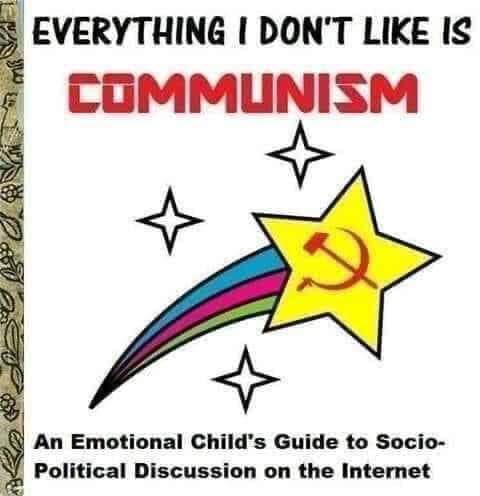
One of the oldest tricks in the right-wing playbook is conflation. If you don’t know what I mean, consider this meme:

It’s a satire of real Internet discourse. Even though communism is an economic system (read: communists are most focused on work- and economics-related issues like labor unions, livable wages and wealth equity) conservatives scream “communism” at any left-wing policy, even on issues that communists would logically have little interest in, like gun laws or climate change. By instilling such a rabid hatred of communism in their voters, conservative lawmakers can turn their voter base against virtually anything proposed by liberals. And that’s the idea with the sudden revolt against CRT. First, label anything having to do with race and academics–diversity, inclusion, and equity efforts, affirmative action, curriculum content, etc.–as CRT. Second, throw in misinformation and false equivalencies meant to stir up white fragility and/or make the counter-protestors look like the bad guys, like: critical race theory teaches our kids that discrimination against white people is OK. And besides, it’s demeaning to black people, teaching them that they’re victims. It’s going to make American education worse, and make white students uncomfortable while doing it. Step three: trot out the anti-CRT measures and profit.

As a matter of fact, Republican politicians already are. Fresh off the success of the Stop W.O.K.E. Act, Ron DeSantis passed HB 1557, informally known as the “Don’t Say Gay” Bill, applying the anti-“CRT” veto to curriculum related to LGBTQ+ history and social issues. Texas lawmakers are trying to pass an identical law. And, likely emboldened by the success of the nationwide smear campaign against “critical race theory,” an onslaught of laws targeting LGBTQ+ rights (with emphasis on the T) have been proposed nationwide since January of 2022.

Where Is This Happening?

The short answer: red states. The long answer can be found in the Forbes article “Teacher Anti-CRT Bills Coast to Coast: A State-by-State Guide.” Some highlights:

  • Arizona has an anti-“CRT” law in place for state agencies and, as of February 16, had two bills in gestation forbidding “CRT” from Arizona schools and one forbidding affirming ideas about race.
  • I’ve already mentioned Florida extensively, but believe it or not, it gets worse. Along with the Stop W.O.K.E. Act and the “Don’t Say Gay” Bill, SBs 242 and 148 aim to remove, quote, “anything that makes students feel ‘discomfort, guilt, anguish or any other form of psychological distress'” from classroom settings. Ron DeSantis is also pushing for parents to be able to sue teachers that teach curriculum they disagree with.
  • It’s a bad time to be a teacher in a state that starts with “I.”
    • Idaho was one of the first states to pass an anti-“CRT” law. Idaho lawmakers are in lockstep with Ron DeSantis in fighting for parents’ rights to sue teachers over teaching ideas they object to.
    • Indiana senator Scott Baldwin made national headlines by demanding teachers be impartial when discussing Nazism and fascism in classrooms. His saying the quiet part out loud sunk that particular bill, but four others–SB 415 and HBs 1362, 1389 and 1134–sprung up in its place. These bills would ban gender and race diversity training and would allow school funding to be pulled if staff didn’t comply.
    • Iowa passed HF 802 in spring 2021, banning “racial and sexual stereotyping” in diversity training (read: they disallowed discussion of implicit bias, a foundational concept in diversity training, from diversity training.) Four bills are pending. One forbids negative comments about the Pledge of Allegiance. Another demands teachers take a Baldwinesque “balanced” approach to controversial topics.
  • In the land of McConnell-induced hell, aka Kentucky, four bills would ban gender/diversity training, discussion of certain topics, and would mandate versions to teach a specific version of American history. Teachers could have their credentials revoked should they disobey the bills.
  • Missouri takes the cake with a whopping sixteen bills promoting standard anti-“CRT” fare: ban on “divisive” concepts, a mandated positive presentation of US history, and a requirement of signing a “non-indoctrination clause,” wherein a teacher must teach all sides of political, religious or ideological debates.
  • New Hampshire must have something in the state drinking water, because along with a bill on the books that would forbid mentions of Marxism, socialism and negative portrayals of the Founding Fathers in classroom discussion, the New Hampshire branch of Moms for Lying to Children–I mean, Liberty–is offering bounties to report rule-breaking teachers.
  • In second place for volume behind Missouri is Oklahoma, with nine bills extending the reach of an established anti-“CRT” law in the pipeline. These bills, along with standard anti-“CRT” fare, would ban certain flags from the classroom, disallow teachers from giving extra credit for political activity, and would allow parents to sue teachers for contradicting religious beliefs.
  • Tennessee was one of the states where the critical race theory panic began. Five anti-“CRT” bills are in the pipeline. One of them is Tennessee’s own “Don’t Say Gay” Bill.
  • One of Virginia governor Glenn Youngkin’s first actions in office was to make good on his campaign promise and sign an anti-“CRT” executive order. Five bills supporting the executive order are in the pipeline. They also forbid teachings that criticize capitalism and have a built-in bathroom bill.
  • In third place for who’s taken the most crazy pills is West Virginia, with seven anti-“CRT” bills in the pipeline. One forbids the discussion of certain topics like communism, critical economic theory, Maoism or Marxism unless, quote, “the teacher includes ‘the scope and scale of state sponsored terror and murder, absence of legal process and protection of civil and political rights, forced labor, economic inefficiency and starvations’ that came with such philosophies.”

Twelve states (California, Connecticut, Delaware, Hawaii, Louisiana, Maine, Massachusetts, Nevada, Oregon, Rhode Island, Vermont and Wisconsin) went unmentioned in the article, but considering the article is 2 months old and that anti-CRT bills have sprung up in Democrat stronghold states like New York and Minnesota, don’t think you’re safe because your neighbors have Biden/Harris signs in their yards.

What Can We Do?

With all this talk of conflation and theory and legal consequences, it’s easy to feel like this is out of your pay grade. I’m right there with you. So, here are practical steps:

  • Wake up and remember apathy is the goal. One lingering way Donald Trump has poisoned the Republican Party is by encouraging intimidation politics. All of these laws, passed and pending, punch down: threatening underpaid teachers with termination and under-funded schools and districts with even less money; fighting to keep underrepresented children underrepresented; and threatening legal action against anyone who speaks up. The intent of these laws is to leave people either too scared to resist or too hopeless to look for ways to fight these laws. So see these laws for what they are–legal bullying–and act accordingly.
  • VOTE SMART. People underestimate how important midterms are. While it’s important who’s President or Senate Majority Leader, there are hundreds of thousands of state and local politicians who can hold up or undermine the decisions of the legal, executive and judicial branches. So, vote in 2022 and 2024, but do your research before you do. Kneejerk voting against X, Y and Z is not only how people like Glenn Youngkin get elected, but also how Trojan horse candidates who campaign one way and legislate another get elected. (Looking at you, Kyrsten Sinema and Tulsi Gabbard.)
  • Maliciously comply… One great thing about dogwhistling laws is since they can’t outright discriminate like you could in the Bad Ol’ Days, the vague language these laws employ can easily be flipped on their head. Moms for Liberty cried about this on Twitter when one Florida teacher obeyed the “Don’t Say Gay” bill by banning all gender identifiers from their classroom, including those of cisgender students, and books that include gender-specific monikers like “mother” and father.”
  • …or obey the letter of the law, not the spirit. In the same vein as the above, conservatives’ revolt against books that might make their kids realize radical ideas like “gay people are human beings” or “you have to be an idiot to think mask mandates make America Nazi Germany II” has backfired horribly. Tennessee’s ban of the graphic novel Maus, which has author Art Spiegelman tell the story of his father surviving the Holocaust, made sales for Maus skyrocket. And because Republicans can’t learn from their mistakes, the same thing happened when Ted Cruz brought out an antiracist children’s book to try to get one over on Ketanji Brown Jackson. As more than one person has pointed out, by issuing extensive book bans, conservatives have served curious children reading lists on a platter. And these children don’t live at school, meaning they’re free to read these scary, brainwashing books so long as they do it outside of school. So encourage your kids to read these books and research these ideas in their own time, a sphere no Republican can touch.
  • Read up on your rights. You better believe these laws aren’t being taken sitting down. The ACLU leaped on the variety of ways anti-“CRT” laws violated students and teachers’ First Amendment rights. You should, too.
  • Find and be support. When heads are put together, corruption falls apart. Whatever criticisms you have of conservative forces in this country, they got at least one thing right: they figured out decades ago how much power you can gather by coalescing people with similar goals. So organize those peaceful protests. Write those letters to officials. Attend school board meetings en masse. Make your coalitions. Your opponents can’t complain; it’s their idea. And be a shoulder to cry on and a listening ear to anyone affected by these bills and laws.

We can dismantle these unjust laws.

But only if we work together.

Resources/Works Cited

The Lost Stories of Spain, vol. 1

I have a lot of stories from Spain.

And here I am telling them!

I’ll be honest: had I been more on the ball while blogging in Spain, you guys would probably know most of these stories already. I’d definitely have a better sense of time.

But I want to have some kind of preservation of these memories, as well as beef up The Keene Chronicles. So here I go.

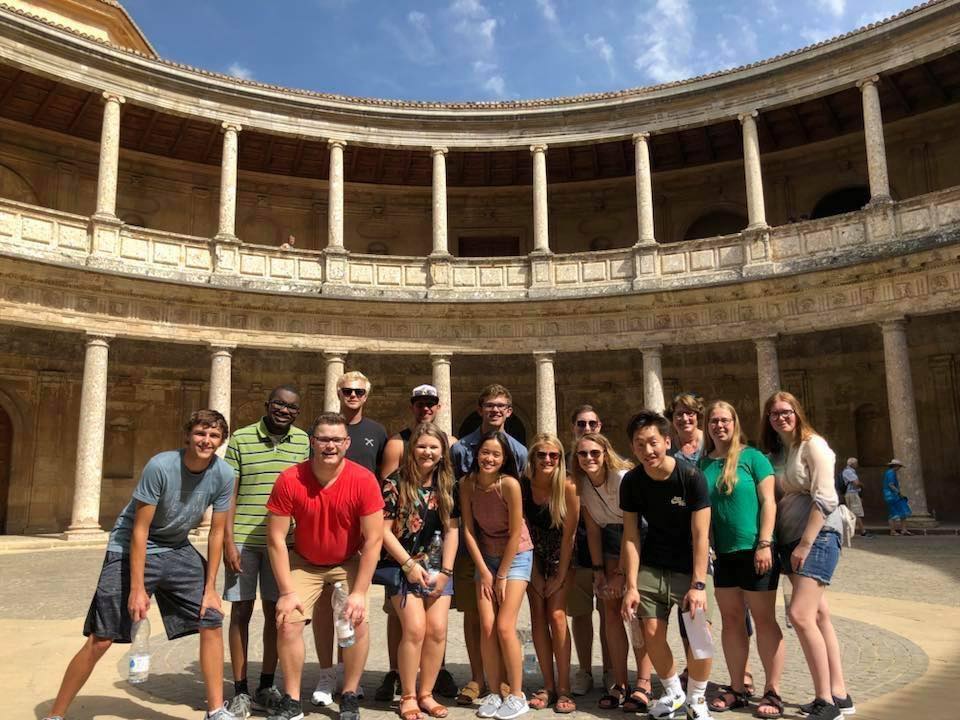
Oh, before I do, let me introduce the rest of my group. They obviously play roles in the majority of these stories.

Clockwise from the middle: Max Israels (between the pillars in the dark blue shirt), Cameron Behnam (sunglasses), Prof. Marcie Pyper, Jessica Wilcoxen (jean shorts), Elizabeth Koning (green shirt), Noah Shin, Amy Bristol, Kassidy Brouwer, Elise Allen, Kennedy Genzink, Matt Rossler, Tanner Huizenga, yours truly, Amy’s older brother Jamie, and Benji Steenwyk. Cameraman: Enrique, our tour guide

I should also warn y’all: a lot of these stories involve alcohol. You should expect as much when you let a bunch of college students (even from a Christian college) into a country where the drinking age is 18.

Alright.

1. THE IRONY!

This happened the first week. I think we were in Granada.

The night that we were staying in Granada, our group split up in the search for food. I ended up in a restaurant with Elise, Elizabeth and Jessica. They ordered alcoholic drinks with their food, while I stuck with Coke. (After a few months there, I can attest: 90% of Coca-Cola’s stocks must come from Spain. If you could prick Spain with a needle, it would bleed Coke and Fanta.)

After they’d had a few to drink, they shifted into more personal conversations: relationships, past jobs, their relationships with their parents, and so on. Seeing as I am single, have worked the same job for the past two summers, and my relationship with my parents is fine (love ya, Mom and Dad) I stayed quiet.

Now, none of these girls are Amazons, but they all held their liquor pretty well. That being said, were we to go somewhere else, we would be walking around a busy, foreign city at night, with three of the four people in the group being not-completely-sober young women. I can put on an intimidating visage, but I doubted I could scare off every creep and pickpocket, so I decided to take the girls back to the hotel and turn in early.

I took them back to the hotel, got them into the elevator, and started the ascent to their floor.

Elise touched my arm. “We’re not trying to make you uncomfortable,” she assured me.

Blink blink.

What?

Now, you need to understand something: I don’t drink. Never have, probably never will. When I told my friends not a drop of alcohol had passed through my lips for the entirety of my time in Spain, I was met with a room full of hanging jaws. Even if I found something appealing about being drunk, I would die at the irony: the son of a man who works with addicts chugging alcohol. That being said, the fact that I go to a Christian college doesn’t mean I’ve never been around drunk people, and seen some truly mind-boggling stupidity caused by drunkenness. These girls were giggly, far from falling through any doors or screaming like they were getting murdered because they were too drunk to find their phone in their pocket.

“Elise, I [have been around drunk people–not mentioning names],” I told her. I held a hand over my head. “This is the drunk idiocy scale.” I dropped a hand down to ankle level. “You guys are like a .45.”

We reached their floor, and I motioned them down the hall. “Oh no, we’ll walk you back to your room,” Jessica said.

Blink blink.

What?

I find videos of women fighting men fascinating. Not because I find anything amusing about violence against women, but because just about every one follows the same formula: it’s always a woman who could be knocked over by a stiff breeze throwing hands with a guy 10 inches taller and 90 pounds heavier than her. Like, what do you expect, lady?

For some reason, this situation reminded me of that. Let me reiterate: the three drunk girls were trying to escort me, the one sober guy, back to his room.

“Wha–no! Come on, your room is down the hall.”

I got them in their room and bade them good night. I stood staring at their door for a few moments and came to this genius conclusion:

People are weird when they’re drunk.

2. The Great Discovery

I can say with near-certainty that this happened in Córdoba.

I’ve mentioned our tour guide, Enrique. On the one hand, he’s a super-cool guy. He has that personality type of someone who would be a dope uncle. He was funny and knowledgeable about his country’s history and a ball of energy. On the other hand, he was also taking my group on a 7-day turbo tour of southern Spain when we were still working through the jet lag. The length of the tour through Toledo also made me come close to pooping myself. (You can read a blurb about that particular experience here.)

But one thing I will be forever grateful to Enrique for: he introduced me to 100 Montaditos.

It was lunch time, and Enrique rattled off a couple of places we could go to eat. He started off by pointing directly across the street to a hole in the wall. The place’s name was 100 Montaditos, and as the name suggested, its niche was montaditos (en inglés, “small sandwich”). I was feeling a sandwich, so I walked in with Elise, Tanner and Elizabeth.

100 Montaditos is what I might call a carbine restaurant. A carbine is a short-barreled rifle, either chambered for the standard 5.56×45 mm cartridge or in a smaller caliber. It’s not as concealable as a submachine gun or pistol, but more maneuverable than a full-length rifle. The same thing can be said for a carbine restaurant: it’s not low-quality enough to be fast food, and not fancy enough to be high-class. I got my food quickly, a la a fast food restaurant. It also served fast food-y…food: French fries, pop, nachos, and cheesy bites. On the other hand, this food was waaaaaay too good to be slapped with a title as derogatory as fast food.

So anyway, I got an order slip, put down the sandwiches and drink I wanted, and handed it to the guy at the counter. When my name was called, I took my plate and started eating.

This place was amazing! I had some great food in Spain, both modern and traditional. But 100 Montaditos was my first food love. I about squealed like a little girl when in one of my explorations of Oviedo I found a 100 Montaditos.

Is it wrong that 100 Montaditos is one of the things I’m most looking forward to should I go back to Spain?

I’m going to assume the answer is no.

3. The Faux Pas to End All Faux Pas…es

As previously chronicled, that first weekend with my host parents was a rough two days. The cringiest moment came when I was done unpacking my stuff and walked into the living room, looking to talk with Elisa and José.

The living room was always dim, even with lamps on. There was a man sitting on the couch, on his phone, who I assumed was a family member I hadn’t met yet. Circe, the family dog who seriously needed to chill, started yapping.

La perro necesita menos azúcar en su comida,” I told the man. The man laughed and nodded. I held out a hand. “Me llamo Noah.”

That’s when the man stood up and walked into the light, revealing himself as José, my host dad.

I don’t remember if I figuratively or literally facepalmed, but it was one linguistic blunder in a weekend full of them.

4. The First Day of Lit Class

Being an international student is a weird, weird thing.

While at the University of Oviedo, I was technically enrolled in three schools. I was at the University of Oviedo, obviously, taking a literature class. I was also at La Casa de las Lenguas, an international school that shared campuses with the university, but was a different entity. That’s where the bulk of my classes were. And of course, I was still a Calvin student.

The first day of lit class, I walked in with Kassidy, Tanner and Noah Shin. We stuck out like sore thumbs: Me and Shin were the only black and Asian guys in the class, Kassidy’s blonde hair might as well have been a neon sign, and while Spanish men might not be as short as stereotypes say, Tanner towered over even the tallest of our classmates. We all sat in a row at the back of the class.

Our professor walked in and began speaking Spanish. I looked down the row, and I’m sure all four of us looked like this:

We had been told that the Lit class was going to be taught in English. As much as I love books, trying to talk about themes and symbolism in Spanish for the next three months sounded like a one-way trip to an aneurysm.

Our professor had a rather odd accent. (We actually had three professors, and none of them had the typical Spanish accent, despite all of them being natives. Our main professor, Luz Mar, had gotten her degree in Ireland and picked up an Irish tinge while she was at it. Marta, who substituted for about a week while Professor Mar was on medical leave, sounded like a French expatriate in the last stages of losing her accent. And Carla, who plays a role in a future story, sounded like she was from one of the posher parts of England.) After maybe 10 minutes of speaking, Professor Mar looked back to our row and said, in that odd Spirish accent, “You do not speak Spanish, yes?”

We all nodded frantically.

She switched to English, which I think was her plan the whole time. We were on the Humanities Campus, and most of our classmates spoke very good English, albeit the Queen’s English.

But anyhow, bullet dodged.

5. Dang It, Maxwell!

If you, the reader, are from Calvin, then you probably already know this story. I’m telling it anyway.

Allow me to reintroduce Max.

Hint: he’s not the guy on the left.

Of all the people who went to Spain, he was the guy I knew best. To heavily paraphrase Captain America, “Even when I was surrounded by strangers, I had Max.”

And then everything changed when la neumonía attacked.

It started out as a cough. Me and Max met up a couple of times to wander Oviedo, and he had a bit of a cold.

Then I showed up to class one day, and Max wasn’t there. Professor Pyper told us he’d gone to the hospital, citing some kind of lung issue.

I was definitely concerned, but not surprised.

You see, alongside [having been around drunk people—still not naming names], I am also surrounded by smokers. My freshman year roommate loved him some cigars, and it was regular to be lying in bed with the lights off and hear the crackle of a vape being hit. Just about everyone in my group of friends smokes and/or vapes, Max included, and Max had been hitting the Kools spectacularly hard in the absence of a vape.

Along with Professor Pyper, I was the first person to visit him in the hospital. I walked in the room, got a good look at the oxygen tubes, and said something to the effect of, “Max, you look like crap.”

I’m joking about it now, but it was a scary time. Seemingly overnight, Max had gotten so sick that I heard whispers of whatever was wrong with him potentially being fatal. Whether the rumors were exaggerated or not, it was serious enough that Max’s parents flew over to check on him.

The test results came back, and by God, if it wasn’t a strange one.

I’m still not 100% certain on the cause, but here’s what happened to the best of my understanding.

Max told us pneumonia was the problem, and just about everyone agreed that it probably happened because of his riding the Camels. We were only half-right. Along with cigarette residue, the doctors also found vape juice. A vape (or vaporizer) vaporizes flavored liquid to produce scented steam, which is inhaled and exhaled like cigarette smoke. Apparently in all of his vaping, Max’s vape had malfunctioned, giving him a breath of juice instead of vapor and trapping the juice in his lungs. When he got pneumonia, the combination of cigarette smoke and trapped vape juice had caused a nasty reaction in his lungs, which prompted the hospital visit.

Max was discharged from the hospital soon after, with the doctor telling him that for his health’s sake, his smoking days were done. Max had the option to stay in Spain, but he ultimately decided to go home. The decision was mostly a pragmatic one: a guy who just left the hospital for lung issues is going to have a hell of a time in Spain.

Seriously, everyone smokes in Spain. I asked for a non-smoking host family on my form, and I got a needle in a haystack.

So, with Game of Thrones shot glasses and much internal crying from me, Max left in early October.

I think the wind just picked up. I don’t know where this sand that blew in my eyes came from.

That’ll conclude today’s edition of The Lost Stories of Spain. More to come, both blogs and volumes of The Lost Stories of Spain. May your vapes function properly, your host dads sit in the light, and your 100 Montaditos be delicious.

2018. Just…2018.

Some things I have abandoned as I’ve gotten older.

For example, I have pretty much phased white shirts out of my wardrobe. Any stain on the material is a thousand times more noticeable when you’re wearing a white shirt. Many story ideas that seemed like 24-karat gold when I first came up with them are now in some graveyard of the mind.

I think I can bury defining years as “good” or “bad” in the same yard.

In times past, I put years under good or bad umbrellas. 2013 will go down as one of the worst years of my life for the foreseeable future, and 2015 will go down as one of the best. But even those years had their ups and downs.

And I think that’s the best way to describe the year of 2018: ups and downs. Well, that, and long. When I think back on some of the things that happened this year—the Parkland and Santa Fe shootings, the death of XXXTentacion, the Brett Kavanaugh trial—it’s mind-boggling to me that it happened in the last 12 months.

I’ve heard that the older you get, the quicker time seems to pass. And, paradoxically, I’ve found that to be true. It doesn’t feel like that long ago I was kicking open my dorm room door and doing the whip in greeting. (Don’t ask; my friends and I are weird.) But at the same time, it feels like this year has moved in slow motion.

So, what to make of this year? Well, I said it already: it had its good, and it had its bad. After the preview of hell that was my first semester, interim and second semester was what I needed. I made some great memories with my friends and family, I met Alvin Plantinga, I learned that Calvin College is the place I want to be, and of course, I WENT TO SPAIIIIIIIIIIIIIIIIIIIIN!

But on the other hand, there were low points. There was the second preview of hell that was the weekend of my uncle’s wedding. (No offense to my uncle, but going to New York is not ideal when you have two papers and the paperwork for studying abroad due.) The summer saw the death of a family friend and some spectacularly bad time management causing me to shoot myself in the foot when it came to getting my driver’s license. It was an uphill battle actually getting to Spain, a struggle to learn the language when I got there, and my closest friend on the trip had to go home early–curse you, pneumonia.

I think the end of the year is the ultimate hill point. OK, death is probably the ultimate hill point, but the end of the year is the penultimate hill point. Behind us is this year, the fantastic moments, the godawful moments, and everything in-between. In front of us is 2019, our returning to our daily routines with nary an idea of what is to come. But the only place to go is forward.

So happy new year to one and all. May everyone have a great new year.

The Hill Point

Camila Cabello, Holden Caulfield and Trip Lee are my best friends right now.

Camila Cabello, in her breakout single “Havana”, sings “Half of my heart is in Havana.” Holden Caulfield, that kid who you either loved or hated in 10th grade English, spends the duration of The Catcher in the Rye feeling trapped between the innocence of childhood and the…whatever it is…of adulthood. Trip Lee recorded the album Between Two Worlds, centered around the feeling of being pulled between the realm of God and the world.

What I’m trying to say is, I’ve been feeling pulled in two directions lately.

The pull was first felt twice in a three-day period. In late October, I FaceTimed my old roommate for the first time since I left. We caught up, had some banter, a few of my friends popped into frame to ask how I was doing, and then he hung up after he recommended I watch The Haunting of Hill House and I told him I wanted to finish Avatar: The Last Airbender first. (Which one of us watched all of The Blacklist seasons in a two-week span, Mitch? You overestimate my power!) I shook my head and tossed my iPad on the bed. It was about 2:30 in the morning, and I started getting ready for bed. I paused and thought over the good times of freshman year, and I felt something like a hole open up inside of me. I shook it off and went to bed.

I couldn’t shake off the next time it happened. I was walking to school and listening to music, per usual. Lecrae’s “I’ll Find You” slid through my shuffle as I reached campus. I paused and listened to Tori Kelly’s chorus:

Just fight a little longer my friend
It’s all worth it in the end
But when you got nobody to turn to
Just hold on, and I’ll find you
I’ll find you
I’ll find you
Just hold on, and I’ll find you

If the hole had been previously poked open with a stick, it was now blown open with a cannonball. I found myself leaning against a tree, trying to avoid crying in the middle of campus. Oh God, I miss home!

A visual representation…

The term “liminal space” was introduced to me in my literature class. I looked it up and found this quote from a friar named Richard Rohr: “…where we are betwixt and between the familiar and the completely unknown…”

If that doesn’t describe me right now, I don’t know what does.

On the one hand, I don’t want the experience of Spain to end. At some point, I finally reached the threshold point of speaking Spanish where I could have a conversation  I’m sure in those conversations, I still sound like a third-grader with a head injury, but the point still stands. I’ve laid down roots: I have a great host family, have made friends from Spain, other American colleges and other places on the globe, and have learned so much, even if the Spanish university system kind of stinks. (Hey, I said I’ve grown to appreciate the country; I said nothing about liking the country’s inner workings.) I’ve made possibly the deepest connections I’ve ever made with the other Calvin kids who came with me, and have made some of my best memories alongside them.

On the other hand, I know I’m living in a snapshot, that just as the Detroit and the Calvin College I will return to will not be the Detroit or the Calvin I left, the Spain I could return to will not be the Spain I left. My friends, Calvin or otherwise, will scatter.  My host parents are in their golden years; it’s a very real possibility that one or both of them will be dead if I ever return.

There’s also the changes I will return home to: political changes (hello, Michigan legalizing marijuana and Republicans’ incompetence being back in my bubble!), a freshman class virtually unknown to me, changes in my group of friends (new relationship count as of today: 5), and changes in myself.

Perhaps an analogy is the best way to close what I feel like is a very confusing blog. My high school, Henry Ford Academy, is a very unusual school. Along with, you know, sharing ground with a museum, the 10-12 campus is in a bowl of sorts, with a hill leading down to the campus. It’s HFA tradition that on the seniors’ last day, the other three classes gather on either side of the hill so the seniors can say their goodbyes to their underclassmen friends before moving on to the next stage of life.

I’m at the hill point. At the bottom of the hill is my time in Spain, a time I know is coming to an end and a chapter I am both happy and sad is ending. At the top of the hill is my life back home: familiar, but with enough of an unknown factor that it makes me apprehensive.

The only place I can go is forward.

Humble Idiocy

Yeah, I don’t know how to start this one. So story time, I guess.

I’ve been in Spain for about a month and a half now. My Spanish has advanced—I’m not fluent, but I can ask questions as well as answer them. I’m picking up on Spanish culture, through observation as I walk through the city, learning the country’s history in the classroom, and interacting with the Spanish students in La Universidad de Oviedo

All that being said, dose of reality, thy name is fútbol.

Feeling the need to interact with my host parents more, I sat down with my host dad and watched the England vs. Spain fútbol game a little while ago. As the game went on, I came to a realization: wow, I know no Spanish words relating to fútbol. I had sat down hoping to make conversation with my host dad, but the topic at hand was one I was out of my element in. I didn’t know the Spanish for positions, so I couldn’t ask who’s on offense? or how is the goalie doing this season? When England scored a point, my host dad pulled out his phone and started looking for his translator. “Yo sé,” I assured him. “En inglés, they scored.” I watched a few more minutes of the game, feeling a familiar sense of frustration returning. My frustration was broken by dinner, but I had been served a healthy dose of reality. From this incident and another, I got firsthand experience of a concept introduced in class: humble idiocy.

The second occurrence happened this past weekend, when I traveled to the Picos de Europas mountain range with a group. I gulped as my eyes followed the cable car cables up the mountain. Oh geez, heights. Not helping was my friend Adam hypothesizing about what would happen should the cable car malfunction. I exited the car, walked up the stairs, and then walked out to the viewing platform.

And this is what I saw…

This might have been the first time I’ve really been in nature. Sure, I’ve been in forests and to the ocean and such, and the fact that I came up on a cable car and took my first couple of pictures from inside the cable car and then over the rail of a viewing platform sort of undermines this statement, but something felt different about this experience.

I felt…tiny.

And I loved it.

As we continued down the path, there was a branch-off that took you down into a field and a natural overlook. I made my way down into the field with a few other guys and walked a stretch. As I weaved through the stones in the field, I gaped at the mountains in the horizon that seemed to go on forever. 

I’m…insignificant. And I’m…strangely OK with that.


We live in a cynical world, one where jokes about wanting to die are the norm and everything is met with an eye roll and a sigh of resignation. I’ve been striving to be a more positive person, but even with that goal in mind, my resistance to cynical thinking hasn’t risen from that. To walk among these huge rocks, to see a mountain so tall that the clouds flowed under its peak, to make the trek up a not-so-steady pebble slope to try and get close to a pair of mountain goats, it made me feel…like a little kid. And that was…a surprisingly enjoyable thing.

Those few hours in the mountains got me thinking about something my friend Tanner had mentioned in class, “humble idiocy.” It’s an in-between between the tourist demand that other countries bend over backwards to accommodate them and the in-over-my-head despair. 

Humble idiocy is finding joy in your limits. Limits to your experience, to your skill. No entitlement and demand that a culture kowtow to you, no “woe is me” and feelings of hopelessness, just rolling with your confusion and persisting in spite of it.

I’ve got about 7 weeks left in Spain. Here’s hoping for more humble idiocy.

El Idiota Humilde,

Noah

P.S. I’ve mentioned my host family a few times now, and it only seems fair that I actually show them.

From left to right: José Villa, my host dad; Sayaka, my sorta-host sister who was with us the first few weeks but returned to Japan at the end of September; yours truly; Circe, the schnauzer who needs less sugar in her dog food; two past host students whose names I didn’t catch; and my host mom, Elisa Villa.

And now I’m actually done.