Today (Sunday) the weather sucked. It was raining when I woke up, still raining when my family got to church, and raining even harder when we got out of church. As we got in the car, my dad connected his phone to Bluetooth and turned on Spotify. A Christmas playlist came on and started to play a classic carol: something quiet and slow. I took one look at the pouring rain out the window and said, “Dad, on a day like this, this is what you want to play?” Dad laughed and clicked around until he found something more upbeat.
As we drove home, with [thankfully] the first of many Christmas songs I’ll hear in the next four weeks playing, a certain singer’s recent posts celebrating the end of Halloween and the coming of Christmas came to mind.
Mariah Carey’s “All I Want for Christmas” is the credit score of music. I was shocked when I learned a while ago that credit scores, that gatekeeping status symbol that can prevent you from buying a house, acquiring a car note, or qualifying for insurance, was released onto the world in 1989. I was similarly shocked when I discovered that “All I Want for Christmas,” a song that’s been inescapable from the fourth Friday of November to Christmas for as long as I’ve been alive, is only 5 years older than my 23 years.
Mariah Carey’s “All I Want for Christmas” is the credit score of music. I was shocked when I learned a while ago that credit scores, that gatekeeping status symbol that can prevent you from buying a house, acquiring a car note, or qualifying for insurance, was released onto the world in 1989. I was similarly shocked when I discovered that “All I Want for Christmas,” a song that’s been inescapable from the fourth Friday of November to Christmas for as long as I’ve been alive, is only 5 years older than my 23 years.
What made “All I Want for Christmas” such a runaway hit?
First, its harmlessness. “Corporate pop” is a pejorative usually tacked on to music seen as toothless or “selling out,” the kind of lyric-light, but catchy song that makes you think of smiling people strolling down the street with Product X in their hands. If you’ve heard it in a car commercial, then it’s probably been accused of being corporate pop. Songs like SHAED’s “Trampoline,”Harry Styles’ “Music for a Sushi Restaurant,” Justin Timberlake’s “CAN’T STOP THE FEELING!”, Tones and I’s “Dance Monkey” and, of course, “All I Want for Christmas” are all songs that could be clumped under the corporate pop umbrella.
Second, its singer. Mariah Carey is the 11th-best selling musician of all time. Between her own fame and the power of a giant record label behind her, success was a guarantee, but I doubt even Carey herself knew how much of an icon she had on her hands when she stepped in the recording booth.
Third, and the reason not enough people think about? It’s happy.
“Duh, it’s happy!” you might be thinking. “It’s a Christmas song.” To that, I say: happy holidays aren’t always happy.
The older I’ve gotten, the more I’ve realized: not everybody can get into the Christmas cheer, and for justifiable reasons. For a lot of people, holiday season is a jab in the fresh wound of having loved ones no longer with them. For others, it means forced contact with family they avoid the other 11 months of the year. For low-income families, having to skimp on presents or opt out of festivities completely is a painful reminder of their poverty. For a long time, it was believed that suicide rates rose significantly during the holidays, though organizations like the CDC have pushed back against this narrative in recent years.
And, when you’re already in the holiday dumps, having to hear slow and melancholy songs like “O Come, O Come Emmanuel” or “Silent Night” for a month straight is like lemon juice squeezed onto a gaping cut. But, like the Kool-Aid Man careening through a wall to deliver fruit-flavored goodness, in barges Mariah Carey, crooning how she wants you to make her wish come true and how all she wants for Christmas is yoooooooooooooooooooooooooooooooooouuuuuuuuuu.
Am I overthinking this? No, no I’m not. Considering Time magazine wrote an entire article outlining the various ways “All I Want for Christmas” became a holiday banger, I’m underthinking this. All the same, I send a message to anybody with holiday blues, a message to myself as well, considering the number of Christmases I’ve shuffled rather than ran downstairs on Christmas morning: you’ll be OK.
So crank that Mariah, warm up that hot chocolate and write up those Christmas lists. And remember, there are worse songs that could be played endlessly every Christmas season.
For most of my childhood, I thought I was an introvert. My preferred hobby was reading, a quiet, often solitary hobby. At home, outside of meals, you’d find me in one of two places: in my bedroom, or at the downstairs desktop computer. And once the computer went to the great Best Buy in the Sky and I got an iPad for my birthday, I was almost exclusively in my room.
But that vision of myself changed in my freshman year of college.
I had a rough opening month of college. After one too many social blunders, I went into a kind of self-imposed exile. I went straight back to my dorm room after classes were done, was usually one of the first ones done when my floor went to dinner, and turned down every one of my roommate’s invitations to go to parties or meet people.
And I was miserable.
Which is how I found out that I wasn’t an introvert as much I was the least extroverted of four very extroverted siblings.
But I’m still not totally sure because, despite feeling energized in the presence of other people, I’m awfully comfortable with the quiet.
And my job has only reinforced that.
I work with middle schoolers. I will until June, when some of these kids graduate and move onto high school, some move up to eighth grade, and I wave goodbye to both groups and stop waking up at 5:30. But in this first month, I’ve discovered something.
Middle schoolers are loud.
In other news, water makes thing wet, it gets dark at night, and every 60 seconds a minute passes.
These days, quiet is rare, especially at work. I have 10 other coworkers, working with various grade levels, and even when I have our HQ room to myself, our HQ room is in the middle school hallway, so I can hear classes next door and the hubbub of class transitions.
All this to say, self-care nowadays is basking in silence.
We live in a loud society. Not to say that society was ever quiet, but in times past, you could get a respite from the screeching of society in ways that you can’t today. With the advent of social media and the ubiquity of smartphones, your personal peace and quiet is regularly updated by your favorite celebrities’ Tweets, your relatives’ Facebook posts, game notifications, a never-ending stream of TikToks–the list goes on.
Sometimes, I think humanity is growing afraid of quiet.
For evidence: consider the stereotype of the quiet schoolchild being a potential mass shooter. Also consider the line in every horror movie: “It’s quiet…too quiet.” Or the question every quiet person has been asked: “why are you so quiet?” As if there’s something wrong with someone who keeps to themself.
I think a life without quiet is a worrisome life. And I think that even though our society is devoted to the destruction of quiet, at our core we still know how important quiet is to our well-being.
After a hellish workday, what do you want to come home to? A crying baby, a barking dog, and the fire alarm going off? Or a quiet home? I rest my case.
Lastly, we must consider the spirituality of quiet. When people think “worship,” they tend to think bombast. Bands like Hillsong or Elevation Worship belting worship songs to crowds of thousands, or a church service, with hundreds of people raising a hallelujah. And I won’t act like that’s not a form of worship. But it’s not the only form. In fact, loud worship might be the farthest thing from adoration, depending on your heart’s intentions, so says Jesus in Matthew 6:
And when you pray, do not be like the hypocrites, for they love to pray standing in the synagogues and on the street corners to be seen by others. Truly I tell you, they have received their reward in full. But when you pray, go into your room, close the door and pray to your Father, who is unseen. Then your Father, who sees what is done in secret, will reward you.
Matthew 6:5-6, NIV
Putting your everything into a rendition of “So Will I” is worship. So is meditation. So is clocking an hour in your prayer closet. So is joining a monastery. So is meditating on a verse, as Dietrich Bonhoeffer encouraged his students to do daily.
Conclusion?
If you’re feeling all over the place, or like your life is moving at a billion mph with no foreseeable slowing, make it slow. Take a brief break–five minutes, 30 seconds–and make your own quiet. Find a closet or a bathroom stall, take some deep breaths, and bask in the quiet.
And don’t be afraid of being alone with your own thoughts.
You might hear a Still Small Voice when you make time for the silence.
Today (November 3) marks the end of my third week at my postgrad job and my second week working. My first week was a week of training. And with job training comes icebreakers.
Icebreakers are a window, a fast track to learning about your coworkers. I learned one of my coworkers is expecting her first child in December. That two of my coworkers went to middle school together. That one of my coworkers is obsessed with cheetah print. (And I saw firsthand the extent of her obsession when I caught a ride with her to get fingerprinted and sat in a car covered from front to back with cheetah print.)
During one of the icebreakers, the topic of Netflix came up; specifically, paying for Netflix. The facilitator asked who paid for their own Netflix, and I was the only person who stepped forward.
And this made me realize: everyone’s an adult differently.
Some of my coworkers are renting apartments. I’m still an adult, even though I’m living at home.
I have a coworker expecting, and another coworker whose daughter’s first birthday is coming up. I’m still an adult, even though I don’t have a lil’un running around.
Most of my coworkers drive to work. I’m still an adult, even though I don’t have my license and get around with a mixture of ride-catching, public transit and walking.
None of my coworkers pay for Netflix. They’re still adults.
We’re all struggling in this strange thing called adulthood. Keep your chin up.
I don’t have a topic for this week’s post in the way I usually do. Today’s post is less of a contemplation and more of a PSA.
Recently, I stumbled across one of the worst things I’ve seen on the Internet, and I have seen some truly horrendous things. But TikTok has destroyed my faith in humanity. One TikTok user in particular.
I found a TikTok user whose entire page is dedicated to invading the privacy of partners–boyfriends, girlfriends, husbands, wives. Her page clearly caters to women, but the “”””””””””””””advice”””””””””””””” she doles out can be used by anyone. Unfortunately.
Now you may be wondering what I mean when I say “invading the privacy of partners.” Do I mean asking invasive questions or demanding to see their phone? No. In the interest of not giving this nutcase any more oxygen than her hundreds of thousands of followers, I’m not going to attach a video of hers. (This is also why I’m not naming this user. She’s not going to get more eyes on her because of me, gosh darn it.) Instead, I’ll quote some of her stellar advice, like:
Listening to my man lie like I didn’t seduce him with bottled pheromones for access to his phone to set his texts to forward to me.
A woman who’s definitely violated a restraining order
If you want to see what they’re talking about: Download a texting app, change her number in your partner’s phone to your new text app number, block her number from his phone, carry on the conversation.
A woman whose pinned video says she was recently broken up with. gee, I wonder why?
Anyway, if I transcribe any more, I’ll be doing harm. The one playlist this woman has on her page is titled “PsychoTok,” where she collects this emotional abuse manual in one place, in case you thought maybe this was satire.
Speaking of emotional abuse, let’s get down to brass tacks, because that’s what this woman’s stock and trade is: giving people tips on how to better emotionally abuse and manipulate your partner. If you take any of this woman’s advice, if you hack your partner’s phone in manners I’m pretty sure law enforcement can’t even with a search warrant, if you’re using techniques identity thieves use to steal people’s credit card info on the person you are in a relationship with, you are abusing them. You don’t actually care about their fidelity or whose photos they’re liking on Instagram, you care about controlling them.
Not only is this abusive, it’s illegal. One article I found claims that people found guilty of hacking can get hit with up to 10 years in prison. And even if you avoid time in the clink, you better believe hacking a phone can be the subject of a lawsuit.
Lastly, even if you do manage to dodge any legal consequences, the tips this woman shares are relationship-ending breaches of trust. When your partner finds out–and they will find out–that’s it. No amount of apologies, justification, or begging will be able to save that relationship.
So, on the very small chance a regular viewer of the Alex Forrest Disciple happen on this article, let me tell you something. My parents look at each other’s phones all the time. My dad’s disclosed to me that my mom knows all his passwords, Do you know how she got them? Hacking? Demanding them in a screaming match? No, she has this info and vice versa because my parents have been married for 30 years. My parents share such personal details between the two of them because they trust each other, not because they think having their eyes on one another 24/7 is the only way to keep each other out of other people’s beds.
So, let me ask you, hypothetical follower of the Lunatic: is constant paranoia, possibly going to jail or getting the pants sued off of you, and dropping a nuke on your relationship and rightfully being branded as “f*cking insane” for the rest of your days worth finding out what your partner is saying in “The Boys” group chat? Especially when it’s entirely possible you do this highly illegal breach of privacy and find something incriminating? And especially when you can get the same info from your partner with no arm-twisting or sneaking around by building trust, communicating with them, and being as open a book as you want your partner to be?
That’s right. After 9 months and multiple whinging blog posts, I’ll be starting my first postgrad job in mid-October.
About a year ago, I wrote a blog post about being single. It’s been a long journey to acceptance that I’ll be single for the foreseeable future. But one of the things that helped me along that journey was the realization I was too fixated on the idea of a relationship. I had to stop and ask myself, If I ever do get into a relationship, will it live up to the standards I’m currently holding it to? And I honestly answered, no.
I was idolizing being in a romantic relationship.
And, as I’ve come to realize when I got a ‘yes’ from my future job, I’ve been idolizing work too.
Merriam-Webster defines the word “idolize” as “to worship as a god” or “to love or admire to excess.” The word is biblical in origin, and the idea of idolatry comes up frequently throughout the Bible. Perhaps the most famous verse about idolatry comes from the Book of Colossians:
Therefore, put to death what belongs to your worldly nature: sexual immorality, impurity, lust, evil desire, and greed, which is idolatry.
Colossians 3:5, emphasis mine
Like most sins, idolatry is a perversion of a natural human inclination. In the case of idolizing humans, we naturally look up to people, be they authority figures like parents and teachers, activists like Martin Luther King, theologians like C.S. Lewis, celebrities like Taylor Swift, or businessmen like Elon Musk. To idolize things–activities, work, financial status–is human psychology. There’s a sense of ambition inherent in the human spirit. Our desire to move forward in life is so strong a slang word, NEET, short for not engaged in employment, education, or training, has sprung up to describe people who lack this ambition.
There’s a myriad of dangers that come from idolization. First, there’s simple disappointment. I’ve mentioned incels before. A few years ago, they made the news for reasons that didn’t end with someone dead: plastic surgery. Several self-identified incels paid top dollar for plastic surgeries to chisel their jawline, give them a few inches of height, or even enlarge their testicles, all in the name of becoming the mythical “Chad.” The problem is these surgeries are external answers to an internal problem. A better-looking exterior doesn’t change the self-loathing, entitlement and resentment that makes up the psychology of an incel, as these men found out the hard way. All their idolizing of an ideal male figure got them was disappointment, a cold bed, and an embarrassing medical bill.
Second is moral decay. Morals are the reason the Bible comes down so hard on idolatry. In the context of Biblical times, many pagan religions practiced their faith in manners we find morally repugnant even today: child sacrifices, ritualistic mutilation, orgies. Numerous times the Israelites embraced paganism and numerous times they suffered the consequences. And consequences from worshipping a false god haven’t stopped because the false god is no longer a little statue or a totem pole. How many relationships have ended because of workaholism (worshipping work) or infidelity (worshipping your sex drive)? How many economic crises have happened because of corporate greed (worshipping capital)? How many people have been hurt, abused or killed by people who worshipped power?
Third, and the one I’m currently dealing with: setting up unrealistic expectations. There are a lot of perks to having a job, any job. Making money, obviously. You can make friends or use a job as a stepping stone to a higher-paying or more enjoyable job. Some jobs let you travel. But, as past jobs have taught me, the best relationship to have is a balanced one. Putting your job on a pedestal, even if the job is hypothetical…isn’t balanced.
So, I come full circle. I start my first job in a few weeks. I won’t idolize it. Neither should you. Topple your idols.
I used to work maintenance at a church. “Andy” was one of my coworkers there. I hadn’t seen him face-to-face since I left the job a few years ago. I’d seen him on Facebook and Instagram, though. Boy, had I seen him on Facebook and Instagram.
You see, “Andy” is on the Trump Train. For the first few years of us following each other on social media, this mostly manifested as the occasional “Share if you’re proud of President Trump” type of post. But the right-wing talking points went up to eleven once the US started closing down because of COVID, and up to twelve once the Black Lives Matter protests started. After one too many posts about faked COVID death numbers and airing George Floyd’s holding a pregnant woman hostage (which never happened) to the world, I unfollowed him on Facebook, keeping us friends but removing his posts from my feed. The last time we spoke was over Instagram, where we had a short debate about the voter ID laws that have been popping up all over the US, fueled by “Stop the Steal” rhetoric.
And yet, I enjoyed the encounter.
“Andy’s” face lit up when he saw me. Our conversation was short, him being on his way out and me being on my way in, but we updated each other on where we were in life and he told me he’d be on the lookout for jobs when I said I was looking for work. We fist-bumped and went our separate ways.
It was…civil. Enjoyable, even. And it made me realize something: I had started to consider “Andy” my enemy.
Now, in order for this post to not sound too tinfoil hat-y, I gotta say a couple of things.
First off, I do not and will never approve of the “bipartisan” rhetoric that’s been touted by the likes of President Biden, Joe Manchin and Kyrsten Sinema. Maybe some lawmakers truly want a more unified Congress, but in practice, “bipartisanship” means watering down of legislation that would help the American people and obstructing that which you can’t water down.
Second, I am not a centrist. I certainly used to be, but those days are done, and my disdain for people who “cAn’T sEe a DiFfEreNcE” between those fighting for affordable healthcare and more social safety nets and those fighting to take people’s rights away and maintain an unequal society is deep.
Third, I’ll be providing evidence for what I’m saying for a reason. I’m referring to this post’s takeaway as “tinfoil hat-y” because the ideas I’ll be talking about are the basis of multiple conspiracy theories, many of whichdress upantisemitismand racism in the guise of“just asking questions.” I do not and will never endorse any of these fairy tales, and unequivocally condemn anyone who does.
Fourth and finally, conservatives aren’t blank slates. Even though the key to the conservative establishment’s playbook is conditioning, at the end of the day, conservatives choose to be multiple types of -ist and -phobic and/or give their support and votes to politicians who are. They have agency, and many of them use it to be awful to people who don’t look, vote or think like them.
Now that I can make trading cards from how many disclaimers I’ve made, let’s get to the meat of it.
If you don’t know the term “chronically online,” you should. The Internet has done a lot of great things: made information more accessible than ever, given people the ability to stay connected no matter where they go, changed work life for the better via work from home and online businesses, etc. However, with these changes for the better has come a change for the worse: echo chambers. With the Internet, you can tailor your life, surrounding yourself with people who think like you, share all of the same opinions as you, obsess over something as fervently as you do, etc.
(Get ready to hear this refrain a lot) This is not inherently a bad thing. In fact, it’s natural: if you’re on Facebook, you’re there to find people you know. If you join a forum focused on a hobby like weightlifting, archery or Dungeons and Dragons, you’ll be surrounded by other weightlifters, archers, and D&D players. The problem is, these spaces can become closed circles. A handful of opinions are taken as gospel, and any naysayers or dissident voices are swiftly excommunicated. Those in the closed circle then feed on one another in a sense, distancing themselves further and further from reality with no one there to say, “Hey, guys, maybe we should look at this differently.”
So how does this pertain to the socio-political state of today?
Multiple studiesfrom multipleorganizations havefound that we’re living through one of the most ideologically divided times in US History. (And before some smart aleck leaves a comment about the Civil War, we didn’t have Pew Research Center handing out surveys during the Battle of Bull Run, now didn’t we?) And, like misogynists slowly poisoning the incel community into a hate group or “fans” giving fandom a bad name via online harassment, that polarization is caused by a minority.
The problem is, in the political landscape, the minority is at the top of the totem pole.
Lee Atwater was a strategist for the Republican Party who spelled out what I’m talking about in an infamous interview where he laid out the reasoning for the so-called “Southern strategy” (trigger warning for racial epithets):
You start out in 1954 by saying, “Nigger, nigger, nigger”. By 1968, you can’t say “nigger”—that hurts you. Backfires. So you say stuff like forced busing, states’ rights and all that stuff. You’re getting so abstract now [that] you’re talking about cutting taxes, and all these things you’re talking about are totally economic things and a byproduct of them is [that] blacks get hurt worse than whites. And subconsciously maybe that is part of it. I’m not saying that. But I’m saying that if it is getting that abstract, and that coded, that we are doing away with the racial problem one way or the other. You follow me—because obviously sitting around saying, “We want to cut this”, is much more abstract than even the busing thing, and a hell of a lot more abstract than “Nigger, nigger”. So, any way you look at it, race is coming on the back-burner.
Lee Atwater
That quote comes from an interview in 1981, when the Civil Rights Act was less than 20 years old. Atwater acknowledged that who the Southern strategy was for–racist whites–were a minority. If they weren’t a minority, Atwater and his cohorts wouldn’t have needed to keep their racism on the down low.
And that’s it in a nutshell.
“Establishment” has become a popular word in politics, i.e. “The Democratic establishment elected Joe Biden as a presidential candidate. The people wanted Bernie Sanders!” And it’s from there we can see the problem: the elites of our society–the politicians, the rich, heck, anyone with a sufficient amount of power–want our nation to go one way, while the populace wants it to go another. And that’s where the polarization comes in.
It’s a matter of divide and conquer. A nation divided is a nation less likely to impeach, trust-bust, unionize, tax and decommodify. That won’t do for the powerful, so they put a lot of legwork in making people stand against their own interests.
They do it through religion. Christian nationalism is a hot topic. Christian nationalists wrap right-wing talking points up in Bible verses and sermons. They have since the days of the Moral Majority, the Jerry Falwell-founded political organization who founded the Religious Right. Christian nationalists pervert Scripture, simplifying a complex religious text that’s an instruction manual for a good life, a history book, and a snapshot of ancient Jewish society down to banning abortion and gay marriage. Christians who hear these messages are groomed to think that to vote a certain way is sinful, and these Christians in turn raise their children with such poisonous theology.
They do it through conditioning. The manipulation doesn’t stop in the four walls of the church. Studies have found that regular viewers of Fox News are worse informed about societal and scientific issues than those who don’t watch news at all. That’s not an accident. Neither are the regular attacks on education, from cutting funding to busting teachers’ unions to claiming curriculum is full of “CRT” or is “grooming” children. On both sides of the partisan divide, a whole intellectual ecosystem has informed. Some outlets/figures/organizations seek to inform. Many…don’t, for a reason. An uninformed populace is a population that’s easily swayed.
And once the masses are under their sway, the powerful target. They point to someone–immigrants, LGBTQ+ people, people of color, the poor–and tell their followers, “They did it! Get them!” then sit back and wait to reap the benefits.
If you want a literal example…
And the crazy thing? It’s not that difficult to get polarized people on the same page.
It’s become something of a trend on TikTok to present left-wing ideas to conservatives, in purposely neutral words. And lots of times, the listener agrees, and only backpedals when the cameraman reveals the idea’s left-wing.
I’m fortunate.
In 23 years of living, only one person I’ve met has proved themselves so despicable that I would consider them an enemy.
I’m looking to keep it that way.
There’s a saying that feels relevant to my conclusion: “You are closer to being homeless than being a billionaire.” Meaning that the people on the other side of the ideological divide have more in common than you than whoever’s pulling the puppet strings.
“Andy” is not my enemy.
Neither are people who think or vote like him.
I’ll never vote for the people they vote for, listen to the pundits they listen to, or join the movements they join.
I’m tired of shooting off application after application and writing cover letter after cover letter and not getting so much as an email back.
I’m tired of feeling like a guillotine blade is inching down on my head every day that I don’t have a job.
I’m tired of avoiding LinkedIn, of not wanting to see my classmates’ new jobs and internships, of not wanting to read any more pandering fairy tales made up by CEOs who want to seem relatable to minimum wage workers.
I’m tired of feeling like a failure.
I’m tired of feeling like my professors put all the effort in that they did for me to have a fart of a launch into the real world.
I’m tired of the real world.
I’m tired of companies manufacturing a worker shortage via dragging their feet with applications and whining, “No one wants to wooooork anymore!”
I’m tired of landlords and rental companies hogging housing.
I’m tired of an American life that consists of bouncing from one ‘once-in-a-lifetime’ crisis to the next: 9/11, the Iraq War, Hurricane Katrina, the 2008 financial crash, the Trump presidency, the COVID-19 pandemic, January 6th, and so many mass shootings and police shootings of unarmed black people that I could make trading cards out of them.
I’m tired of a Christian life that consists of trying to steer a spiritual boat around the icebergs of Christian nationalism, homophobia and spiritual abuse.
I’m tired of transparently corrupt politicians–dogs being wagged by lobbyists and corporations, mouthpieces for white supremacy and militia groups, chickenhawks who send other people’s children off to war from the comfort of their cushy office, wealthy nepo babies who cut off free lunches and Social Security because they think it will turn the less fortunate into “welfare queens”–not facing consequences.
I’m tired of living in a world where the most successful people are those who cheat, steal, backstab, exploit and destroy.
I’m tired of corporations that dump oil in the oceans and raze the Amazon gaslighting the populace, telling us to use metal straws and take shorter showers to clean up their mess.
I’m tired of feeling like my life is a time loop, doing the same things day after day.
I’m tired of feeling like nothing will change.
More than anything, I’m tired of being tired.
If you’ve reached the end of this and feel concerned for me, don’t. If you’re like me, you’ve come across something from high school, something you wrote at the height of emotions: a poem about a breakup, a journal entry where you thought high school would never end, music you listened to when your depression seemed inescapable. And while you cringed at it a little, it also made you feel a little better, because those problems that seemed as big as mountains are no more, an afterthought far, far back in the rearview.
I’m hoping this post will be one of those time capsules, something I can come back to 1 or 5 or 10 years and see how far I’ve come.
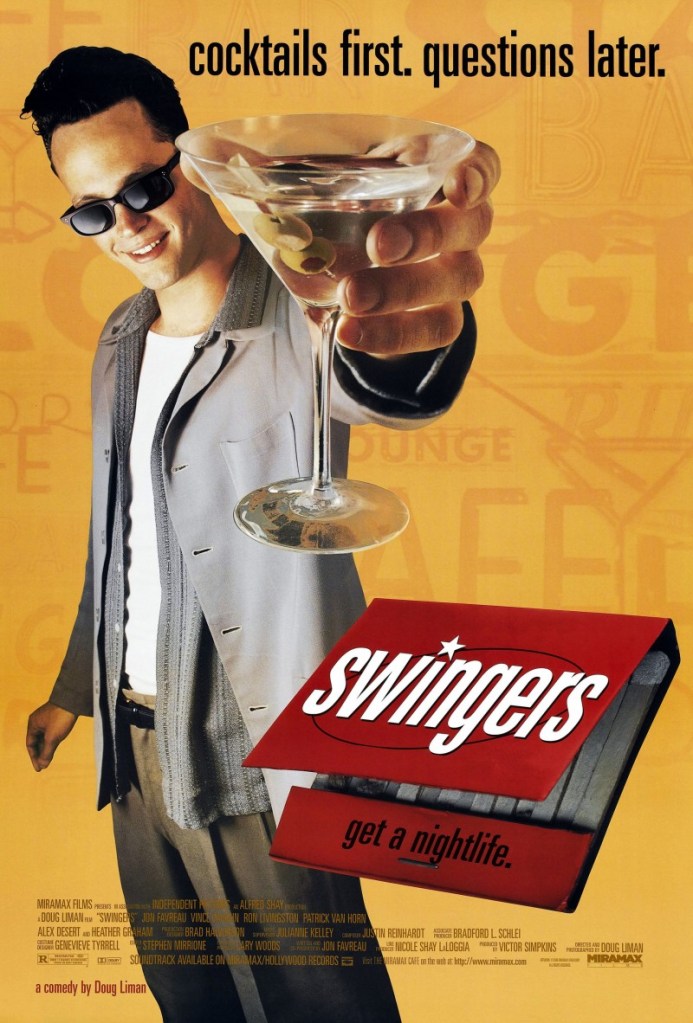
One of my favorite movies is one I can’t mention in good company.
Swingers, made in 1996 and starring Jon Favreau, Vince Vaughn and Ron Livingston, is not about married couples who sleep with other married couples.
Though the poster might make you think otherwise.
The title comes from swing dancing, which had a revival in popularity in the mid-1990s, and factors into the plot of the movie. The movie is about Mike, played by Jon Favreau, a struggling actor in LA whose girlfriend broke up with him six months prior. The abrupt ending of his relationship has made him feel worse about his life, hosting open mic nights no one comes to and watching his best friend Trent, played by Vince Vaughn, pick up women like that. The film focuses around Mike slowly regaining his confidence, helped along by his friends.
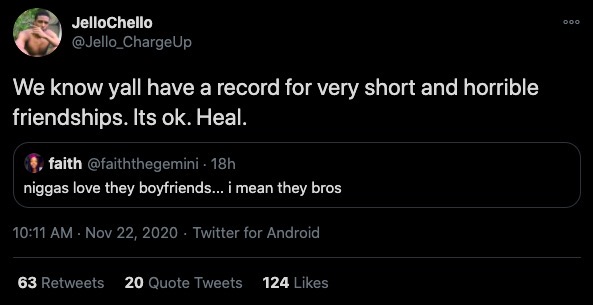
Which is part of the reason I like it so much. In a world where Tweets like this exist
it’s refreshing to watch a film where male friendship is at the center of it, and it’s never dismissed as a “bromance” or include jokes about the characters possibly being in the closet. But I also like it because it makes me think.
One thing in your face from the start is how jealous Mike is of Trent. And there’s lots to be jealous of. Mike’s understandably depressed about his ex-girlfriend breaking it off with him, and Trent’s unfailing cheerfulness is grating when Mike is dealing with such a loss. Trent’s so comfortable with himself that when Mike inadvertently sabotages a one-night stand, Trent shakes it off and moves on, showing confidence that Mike desperately wants to have. Also, Trent draws women like a magnet, which to the freshly single Mike feels like repeated steel-toed boots to the crotch.
And then in the climax, Rob, played by Ron Livingston, flips Mike’s perspective for the better by pointing out how much he has.
And made the video I watch whenever I get bummed about being unemployed.
No, Mike isn’t an A-lister swimming in women, but he has an agent and is part of actors’ unions, while Rob recently got rejected from a job as a theme park mascot. It’s this paradigm shift and reminder of what successes he does have under this belt that allows Mike to end his grieving stage and put himself back on the dating scene.
Haven’t we all been Mike at some point?
No one is immune to groveling, to thinking literally everyone has it better than you. I know I’ve definitely been envious, and my inner Mike is especially apparent because too often, that envy has revolved around relationship status.
But, much like Rob dropping in to completely flip Mike’s self-image on its head, something changed my perspective: reading.
All through 2021, every time I read a book, I’d post a short review on my Instagram story. It was a super fun experiment. Friends would ask me what I was reading or if I’d read a certain book, make recommendations or ask me for one, or (in one case) introduce me by saying, “He’s read every book ever written!”
I’ve known for a long time I’m a fast reader. I was tested back in middle school and learned I read about 600 words a minute. Seeing how that test was almost 10 years ago, I might have sped up or slowed down. But until I started getting positive feedback, I’d never considered my reading skills enviable.
And yet, it was and is.
So, that’s my message for today: you are enviable.
There is always going to be someone more successful than you, and you’ll only make yourself miserable to get what they have. But your life will get better when you realize the people you envy envy you right back. You are enviable. Say it out loud: I am enviable. And stop telling yourself there’s nothing interesting about you. Humans are myopic. We focus on negatives. A talent that’s obvious to everyone around you might never cross your mind.
It’s amazing what you find while panic-writing a paper at 3 in the morning.
The year? Sophomore, almost over. The class? Eschatology, the study of the book of Revelation. The professor? Two things to know about him: 1. His cousin is one of the co-authors of the Left Behind series, which made for an interesting class because Reformed theology looks at the end times in the complete opposite manner of the Left Behind books. 2. He was one of those people whose mind moves at a gazillion miles per hour, making an already-tough class tougher. So there I was, frantically flicking from Word doc to Google to Spotify to Google and back. In my Googling, I found a page called “Theodicy: An Overview” from Dallas Baptist University.
And then everything changed.
Recently, I was reading back through some old assignments, and my Eschatology final paper was one of the papers I looked at. After cringing at my writing from 3 years ago, I took a second look and thought, “You know, I could make a blog post out of this.”
So, consider this my sort of mission statement. This is what I believe.
The Soul Making Model Theodicy
A theodicy is “the defense of God’s goodness and omnipotence in view of the existence of evil,” so says Merriam-Webster. It’s a key idea in Christian philosophy. Saint Augustine, one of the most important thinkers in Christianity, has that status in part because of the Augustinian theodicy. Alvin Plantinga, a philosopher in the Calvinist Reformed tradition, has also devoted his career to theodicies, writing the book God, Freedom, and Evil to put his own theodicy out in the public sphere. But the one that makes the most sense to me is the soul making model theodicy. To quote the overview:
Evil is a necessary condition for a world in which we overcome obstacles and struggles in order to develop. In fact, many higher-order goods (e.g. self-sacrifice, endurance, courage, compassion on the poor, etc.) are not possible unless we have to overcome evil.
Philip Irving mitchell, “Theodicy: An Overview”
Now this is not to say that I nor anyone who upholds this theodicy looks at injustices in the world, shrugs and says, “Deal with it. It builds character.” Rather, we believe that we are myopic. The most obvious statement: pain is uncomfortable. Humans don’t want to deal with things that are painful, and so when something painful happens, it’s easy to think that God has either abandoned us or is trying to punish us. It’s often only in hindsight that we can see how God was using our pain for the good.
Support for this is everywhere in the Bible. The story of Joseph, for instance. Joseph was sold into slavery by his own family, falsely accused of rape right as his life in servitude was looking up, and languished in prison despite a fellow prisoner promising to help him win back his freedom. But all of this put him in the position to save millions of lives when famine devastated Egypt, and reconcile with his brothers and reunite with his ailing father in the process. When Joseph revealed his identity to his brothers, he paraphrased perhaps the most famous verse from the Book of Romans, a verse you could say is the Soul Making Theodicy in a nutshell: “And we know that in all things God works for the good of those who love him, who[a] have been called according to his purpose.”
But this isn’t enough. It’s easy for the soul making model theodicy to be misconstrued into a cop-out, an excuse Christians can use to shy away from life’s miseries with a dismissive “God works in mysterious ways.” No, the theodicy must go hand-in-hand with…
Eschatological Hope
An extension of this is that the Church should be a community that looks to that future justice by modeling it now: believers are to avoid fatalism and work toward God’s promised shalom, a future of perfect peace and justice that begins in God’s work on the cross. Resistance to evil and suffering can be a form of obedience to God.
“Theodicy: An overview,” emphasis mine
I hate Joel Osteen. I mean, I hate prosperity theology and any huckster hack preaching it, but I take Joel Osteen’s existence personally. He made headlines in 2017 for dragging his feet to open the doors of Lakewood Church to those victimized by Hurricane Harvey. Lakewood is one of the largest church facilities in the country, with a congregation 45,000 strong and the seating capacity for almost 17,000 people. Osteen tried to justify the church’s slow response time by saying the church was “inaccessible” due to flooding, only for several amateur photographers to dispute him by snapping pictures and videos of Lakewood’s facilities, barely affected by the hurricane. Lakewood’s representatives made a counter-argument by posting their own videos, showing Lakewood’s parking garages and other areas submerged in floodwater.
Who you believe in this situation isn’t important, nor is the fact that Osteen eventually opened Lakewood’s doors to those in need. What matters is the optics. Joel Osteen claims (keyword: claims) to be a Christian. He had a prime opportunity to care for the least of these and he squandered it.
In C.S. Lewis’ book The Great Divorce, the narrator finds himself on a bus to Hell. After reaching Heaven, the narrator’s guide, Scottish minister George MacDonald, asks the narrator to look at a crack in the soil. He tells the narrator that the entirety of Hell is no bigger than that crack compared to the glory of Heaven. This is the idea of eschatological hope: that in the grand scale of eternity and God’s love, human suffering is but a blip of inconvenience in the journey.
That’s only one half of it, though. I’ve witnessed people, especially during the worst of the pandemic, spin ideas of eschatological hope into a kind of spiritually based toxic positivity, minimizing people’s dismay and depression with sweet nothings: “Let go and let God.” “In Heaven, it will all make sense.” No, to truly abide by eschatological hope involves action. To be eschatologically hopeful, Christians must make priority fighting injustice and suffering in this lifetime rather than waiting for it to disappear in the next.
Óscar Romero was a prime example of eschatological hope. The Salvadoran archbishop refused to submit to the dictatorship of General Carlos Humberto Romero and advocated for the poor, who were caught in the civil war between General Romero’s forces and the guerrillas resisting his rule. Óscar was so dedicated to loving the poor that his final sermon, in which he was cut down by an assassin partway through, was a plea for the members of the congregation to not participate in the government’s routine violations of human rights.
Jesus commanded us to “take up your cross and follow me.” Crosses are a tool of torture and agonizing execution. If your theology emphasizes comfort and complacency, I recommend finding a new one.
“God Is Not Mad At You”
I listen to a podcast, formerly called “The Non-Partisan Evangelical,” now called “The Post-Evangelical Podcast.” While the host Paul Swearengin’s views have evolved, hence the podcast’s name change. But there’s a phrase he’s pushed that’s stuck with me: “God is not mad at you.”
I think God’s anger has been overemphasized. It’s the basis of so-called “fire and brimstone” preaching, sermons that say, “Be good or burn in hell.” The consequences of deemphasizing God’s loving nature are becoming apparent. One of the many reasons the exvangelical movement has gained steam is because the shaming nature of angry God theology traumatized a generation of church kids. When any step out of line, whether that be such a bad decision as getting drunk or something as trivial as holding hands or girls showing cleavage, puts you on the road to hell, can you blame these kids wanting nothing to do with their Heavenly Father when adulthood finally gives them the freedom to make church optional?
Now, this is not to say God can’t get angry. After all, God is a God of justice. But to say he’s only angry is a disservice. And it’s false. The story of Bible is the story of a sad God, not an angry one. This is a God who was in perfect unity with humanity, until they were led astray by the Great Deceiver. He so yearns for His children to be back on the same page with Him that He sent His own son to die so we could be reunited with Him.
God doesn’t hate you. He’s not a strict disciplinarian, waiting for you to screw up so He can drop a hurricane on your house as punishment. He’s not keeping a checklist, chuckling in anticipation of when He can see the look on your face as the trapdoor to Hell opens under your feet. He loves you, and He’s eager to see you come back to Him.
This is what I believe: that God allows suffering with a purpose, to make us better people and to cultivate care and love for our brothers and sisters in Christ. It is our duty as Christians to alleviate and stop the worst and/or unnecessary of suffering: war, rape, genocide, wealth inequity, slavery, etc. And God’s not doing this out of spite; He’s not mad at you and me.
You know what? I’ve been going on and on about negative stuff. Let’s hear about some good news.
Today I want to talk about 988.
Hi, everyone, and welcome back to Today I Want to Talk About… (TIWTTA), a series where I take a topic and break it down into something digestible. And today I’m talking about some long-overdue news: the 988 emergency hotline.
What is 988?
988 is a new emergency number set to go live on July 16 of this year. Everyone knows 911 is the number you call for emergency situations and some people know there are local non-emergency numbers you can call for situations that don’t require police. 988 is a first: an emergency number exclusively dedicated to mental health emergencies.
How Will It Work?
988 is being backed by over 200 crisis centers across the United States. Once it is online, it will work virtually the same way as 911. When a person dials 988, they’ll be connected to a local crisis center. This endeavor is closely tied to the National Suicide Hotline, and a 988 caller will be connected to local counselors, the same way they would by dialing the suicide hotline.
In terms of funding, even though 988 is being rolled out now, it was approved in 2020 under the Trump administration. It’s funded by the Department of Health and Human Services with money allotted to the cause by the American Rescue Plan. The National Suicide Hotline Designation Act, the legislation that got 988 off the ground, gave state governments the green light to point telecommunication fees in the direction of 988 to bolster the money the national government is putting into it.
What’s the Big Deal?
On the world stage, the United States is tragically behind the curve in the conversation on mental health. In an article on 988, the National Alliance on Mental illness said that 1 in 4 people fatally shot by police between 2015 and 2020 were in the midst of a mental health crisis when the police were called to the scene. In addition, 44% of people in jail and 37% of people in prison have some kind of mental illness. And the very nature of prison not only means mental health resources are negligible to nonexistent, but that incarceration is guaranteed to worsen symptoms of mental illness.
Everyone has bad mental health at one point or another, and everyone has the right to good mental healthcare, in the same way everyone has the right to healthcare. 988 is a potential first step for a new, better conversation on mental health in America.
I started drafting this post before the news about Roe v. Wade‘s overturning, so I’m fully aware that the news about 988 feels like small potatoes compared to that news. So take heart, dear reader. Hope springs eternal. Until next time.

 The Keene Chronicles