Look Upon My Works

I entered my friends Ben and Jelz’s room and swung the door shut behind me, my hood up and my head spinning.

My friend Josh looked away from Black Ops 4 for a second and said, “Noah, you look like the Punisher.”

“Josh, what’s the Breaking Bad episode where everything goes sideways for Walter? Was it ‘Ozymandias’?”

“Yeah, that sounds right.”

“Today is ‘Ozymandias’.”

I never got drunk in Spain, but I think I got a little drunk off the experience. That’s the only plausible explanation for why I thought taking 16 credits in the spring would be a good idea.

As for running for Student Senate during the sweatiest semester I’ve had at Calvin, I have no explanation.

People asked me why I was running for Senate during campaign week. My stock response was that I didn’t want to be an armchair critic, and if I had problems with Calvin (which I do) becoming a senator would be the most direct method of dealing with them. But that wasn’t the only reason.

Maybe it was because a few of my mentors had suggested the circle of friends that would come from a club or student org would be healthy. Maybe it was because a few of my friends were on Senate, and working with them sounded fun. Maybe it was because student government would be killer for my LinkedIn page. Maybe having something as time-consuming as being a senator would be the kick in the pants I needed to get my life in order. Maybe it was a little of all those things. Whatever it was, I ran.

If you couldn’t tell by now, I didn’t make it.

I think I went through a couple of stages following the announcement of the election results.

Stage 1: Acceptance. The person with the most votes didn’t surprise me; she was an RA and an international relations major, so she had an entire dorm behind her along with a major that by its nature gave her political acumen.

Stage 2: Indignation. That came from the second winner and first runner-up. Two people made it to senate through the initial election; the second winner was knocked out with an ear infection for most of the campaign week. The person who came in third was a surprise; I didn’t even know she was running until the night before results were announced. After some snooping, I found out why: because she hadn’t campaigned. Which is where the indignation came in: Are you telling me I lost to someone who couldn’t campaign and someone who didn’t campaign? How little trust do people have in me?!

Granted, there were other people who had beat me–I came in sixth–but those two results really got under my skin.

Stage 3: Discouragement. I was not in Stage 3 when I burst into Ben and Jelz’s room asking about Breaking Bad episodes. That came the week after.

I’m confessing to the world: I almost had a date.

I asked one of my friends if she wanted to get Bob Evans on a Monday where we didn’t have class. And she agreed.

Then things came up over the weekend, and she decided to call it off, and told me she didn’t feel the same way.
Which is where I ended up: sitting off in a corner, seriously considering whether I was going to fail two of my classes, not a senator, and trying to figure out what the phrasing for getting rejected after a yes is. (Conclusion: asking out=shooting your shot, rejection=missing, my situation=ricochet…or something.)

Which leads into Stage 4.

Stage 4: Introspection. After the emo stuff had gone on for long enough, I started thinking.

I’ve taken some serious L’s this year. What I’ve mentioned is an incomplete list, but they’re the big things. As I thought through it, I started to see something resembling the bright side. I was on the come up in my struggle classes (or at least, it felt like it), so those weren’t as much of concerns as they had been a few weeks before. Being on next year’s Senate might be a bust, but I got my name out there. I took a risk, something I feel I don’t do often enough, and got good information that could be used for a future shot at Senate. I got 445 votes, and proof of something I sometimes have a hard time believing: that there are people in my corner.

As for getting shot down? Rejection SUUUUUUUUUUUUUUCKS (did I mention it sucks?), but as punches to the soul go, this was more of an angry toddler punch than a prizefighter punch. This friend, who I’m purposely leaving unnamed, named not leading me on as her reason for calling it off, so yay to not getting strung along. And she set the tone: things are only as awkward as you make them, and there’s been a minimum of awkwardness between the two of us.

Stage 5: Turning the Phrase I’d Been Muttering to Myself on Its Head. Which brings me back to Ben and Jelz’s room, asking about the titles of Breaking Bad episodes.

The episode title comes from “Ozymandias”, a poem by Percy Bysshe Shelley. The narrator meets a man who stumbled on the ruins of a kingdom while wandering through the desert. On the pedestal of a statue of the king are these words:

`My name is Ozymandias, King of Kings:
Look on my works, ye mighty, and despair!’

I found myself muttering those words to myself a lot as the school year wound to a close.

I look upon my works.

But I don’t think I’m going to despair.
Tourism: Never Again

A friend and Green Book have forever ruined the idea of being a tourist.

My suitemate from last year dated a girl from Hawaii for a few months. At some point, the topic of her home came up. It was at that point she told me about the love-hate relationship most Hawaiians have with tourists. Tourists to the Hawaiian islands have a tendency to not only be incredibly rude and disrespectful to locals (obviously a big no-no), but also highly disrespectful to the local flora and fauna. If you’re looking for a way to make Hawaiians hate you, it’s disrespecting their nature. She also told me that as much as most native Hawaiians hate tourists treating their home like crap, at this point Hawaii’s economy depends so much on tourism they have no choice but to grin and bear it.

After she was finished talking, I blinked and said, “Well, never going to Hawaii.”

The conversation was dredged up from my memory a few weeks ago when I saw Green Book.

There’s been a lot of conversation on the unsavory aspects of the film. Having seen the film myself, the nicest term I can come up with as a description is “tone-deaf.” The film shows a fictionalized version of the relationship between black pianist Don Shirley and future The Sopranos actor Tony Lip. Lip acts as a driver and bodyguard for Shirley while he does a tour through the Deep South.

On the surface, there’s nothing wrong with the movie. Viggo Mortensen and Mahershala Ali have great chemistry, the dialogue is good, and the film’s aesthetic is a good one. It’s what is under the surface that presents a problem.

Green Book is a white person’s civil rights movie. Previous films about civil rights issues, films like Selma and Detroit, did not shy away from the human rights violations black people could face at the time simply because of their skin color. They didn’t shy away from the violence or the verbal abuse or the humiliation brought about by racist policies or how their families or non-black allies were put in racists’ crosshairs. Green Book does.

Despite wanting to project an anti-racism message, the brutal reality of the racist South is downplayed in the film, seemingly to not make the viewer uncomfortable. Don is beaten up once and harassed by police, but these matters are quickly resolved. He rides comfortably in the backseat of Tony’s car for scene after scene. And the internal turmoil Shirley experiences in a racist society is relegated to one or two scenes.

While it would be accurate for a white man to have some bigoted ideas in the time period, it’s the writing of Tony Lip’s character that really makes the film qualify as “tone-deaf.” In one of his first scenes, Tony and several of his male family members loiter in his apartment as two black workers renovate their kitchen (an obvious reference to the “black men can’t control their sexual urges around white women” idea) and throws away drinking glasses that the workers drank from. A few scenes into his tour with Shirley, he stops at a Kentucky Fried Chicken and all but forces Shirley to eat a couple of wings, claiming that Shirley’s “people” love the stuff, and in spite of Shirley voicing his dislike of the food. And a few scenes before the previously-mentioned “internal turmoil of Don Shirley” scene, Tony labels himself “blacker” than Shirley, listing off several stereotypes of black people that he fits and Shirley doesn’t. Even the seemingly-happy ending–where a changed Tony Lip invites Don Shirley to Christmas dinner–rings hollow. Society has not changed, Shirley will still experience racism, Jim Crow laws still loom over African-Americans, and the titular green book (a safety guide for black people traveling through the more openly hostile parts of America, which is relegated to a few brief shots and one cursory glance by Tony) will continue to be needed for years to come.

Whatever message Green Book has about racism is drowned out by its bending over backwards to cater to a white audience.

*exhale*


Sorry, this blog post briefly turned into a review of Green Book. There was a purpose to it, though.

For my Calvin class in Spain, we read a book called There and Back. Chapter 2 of the book provides a definition of what I’m talking about in this post: tourism mentality. I quote:

“A tourist seeks to escape from his or her life situation and circumstances in a search for entertainment and the exotic. […] Even though tourists want to empty themselves of their routine or imposed timetables, they remain separate from the culture they visit and like moviegoers observe rather than participate.”

If you don’t quite get it, here are some of the things I found when I Googled “tourist”:

Obese American tourist who forced a flight attendant to wipe his bottom dies overseas

Barcelona is more willing to welcome migrants to Catalonia than tourists

Tourists to the Netherlands trample fields of flowers in their quest for selfies, affecting the wellbeing of Dutch farmers

Tourists make a stir by streaking at the most sacred temple in Cambodia

Two tourists brawl over who can take a selfie in front of Rome’s Trevi Fountain; other tourists get in legal trouble for illegally bathing in the fountain

Tourist almost loses an arm after reaching into a cage to pet a lion

The Komodo Islands to be closed to tourists through 2020; officials cite tourists stealing Komodo dragons and the damage they have done to the dragons’ natural habitat

And of course, all of the people who have lost their lives in the pursuit of the perfect selfie.

This is tourist mentality: the entitlement, narcissism and sometimes life-threatening stupidity towards other cultures that demands a whole culture kowtow to your wants. Tourist mentality permeates through Green Book, which glosses over the dark parts of America’s past to pander to a white audience.

But despair not, reader. There is an alternative to tourist mentality: pilgrimage.

Unfortunately, There and Back is on my bookshelf in my dorm room, and I type in my bedroom, so definition of “pilgrimage” instead comes from a Patheos article:

“Now the pilgrim takes joy in the journey with the understanding that the journey only exists because of the destination. […] The pilgrim — somewhat idiotically, I suppose — is interested in some thing at the end of his pilgrimage.”

I don’t know if my time in Spain could be called a pilgrimage. I definitely enjoyed the journey, but I’m not sure what the thing at the end of my pilgrimage was. Better comprehension of Spanish? Making a tight-knit circle of friends? Gain a new appreciation of Calvin College because holy crap, Spanish universities are for the birds?

Who knows? But here’s what I do know: I hope to travel again, some day.

And it won’t be as a tourist.

I’ve Been…

*flicks on light*

Wow. Um…I didn’t know it was possible for a digital space to get cobwebs.

Well, hello, readers. I know it’s been a minute. But I’m back, and I’ll be making an effort to make more posts.

How do these things usually go? Example that seems unrelated that leads into the topic of the day. Right…

The Rudyard Kipling novel Captains Courageous revolves around Harvey, a proto-Kardashian who has spent his whole life being pampered by his wealthy parents. When he is lost at sea, he is picked up by Portuguese fishermen. Harvey is at first thrown off by the rough lifestyle of living on a fishing boat, but eventually joins in the work and grows adapted to the lifestyle. The novel ends with a matured Harvey reuniting with the parents and, with previously unseen resolve, heads off to Stanford to prepare himself for running the family business.

Now, I’ll be honest: I’ve never read the book. This is a summary cobbled together from passing references to the book I’ve heard and a cursory glance at the summary on Wikipedia. But there’s one aspect I’m pretty sure Kipling skimped out on: Harvey’s process of readjustment.

Going from a life of luxury to a life of menial labor with no warning. Being dropped into a crowd of people from a foreign culture, whose mother tongue is not your own. Going from never having done a day of honest work in your life to working your fingers to the bone regularly. I can imagine the reverse culture shock would be real for Harvey.

Well, I don’t imagine. I know.

Today marks 3 months since I started the trek back to the United States. I was lulled into a false sense of security upon returning home. Aside from jet lag, nothing seemed crazy different. Of course people wanted to hear about my experience, but I went to church, visited family, celebrated Christmas, and vegged out on the PlayStation. Nothing different from my time in the summer, aside from a lot more thoughts in Spanish.

Then I returned to school.

My first clue that things were different, and not in the good way, came on my first night back in my dorms. As me and my friends were getting caught up, we talked out into the hall and ran into three girls I only sort of knew from last year. They joined us, and I ended up sitting around, nodding idly as a bunch of references to events I wasn’t present for flew past my head.

Then they started private school kid-ing.

Private school kid-ing: [prahy-vit skool kid∙ing]

verb

A condition in which adolescent or young adult-aged humans from an upper middle-class to upper-class background become so absorbed in their upbringing that they form an echo chamber where the unifying point is: they have money. Named for the commonality of many victims of private school kid-ing having gone to private schools.

Examples of private school kid-ing include, but are not limited to: casual discussions of crashing your car, mentioning you’re going to your cottage this weekend, extended discussions revolving around Patagonia or Lululemon, reminiscing about your senior year class trip to Costa Rica, or breaking from one of these or similar conversation points only to see your friend(s) who went to public school and/or don’t have parents paying their way through college with a glazed-over expression.

Once the discussion turned to AirPods, I made my leave. My thought process can be summed up as such:

The hard thing about returning is the realization that time didn’t stand still while you were gone. The freshmen you live with aren’t the strangers to each other they were when you left; in the case of my dorm, they’re a tight-knit bunch. Great for them, not so much for the guy who was gone for all semester and is trying to make new friends like a socially-healthy human bean. New friends of old friends are great, too; these new friends having in-jokes and/or drawn-out conversations revolving around stuff you don’t know about? Not so much.

Now, enough talk that makes it sound like my friends and floormates are horrible people. (Much love to the broskis, the…siskis?, and 2nd Boer.)

I should mention that I came back during interim, which is Calvin’s equivalent of a J-term. It’s a time where you can take a class, but it’s also a time where a lot of people take some R&R or go on month-long study abroad trips or non-academic trips. You can imagine the kind of disappointment experienced when you haven’t seen someone in 4-13 months, return to school, only to learn they’re in [Arizona, Ireland, Mexico, Cambodia, Austria…] I enjoyed my interim class on The Inklings (read The Great Divorce if you haven’t), but in many ways, it was a lonely three weeks.

Are you guys getting sick of this ‘feel bad for meeeeeeee’ crap? Because I know I am.

With the start of the semester came the return of several things I had been missing: human contact, friends who had been elsewhere, more opportunities to see said friends since people were out of their rooms for more than three hours a day, and a little more time to get readjusted from the relatively lax schedule of La Universidad de Oviedo. (Thanks for that last one, polar vortex. Could you freeze fewer people to death next time?) Last month, I went to Calvin and Hope’s first Re-Entry Conference, a conference designed to help returning students get readjusted. I laughed and nodded along with people returning from Ghana, the south of Spain, Hungary and other places as they told of their good times and their struggles with reverse culture shock. I wrote down suggestions to help me and walked away thinking that was what I needed.

Maybe I’ll never be the same after my time in Spain.

And maybe that’s not necessarily a bad thing.

My I-Almost-Died-But-It-Was-Amazing Story

The most infuriating things in life are the things that are annoying, but necessary.

Take politics. I would try to put my opinions on the Democratic and Republican Parties into words, but said words would probably be quite vulgar and my parents read this blog. On the other hand, history has shown us the alternatives to a democracy, and they aren’t pretty. Or medical treatment. Multiple times a year, we have to go to different doctors to have them examine our eyes, our teeth, our—OK, you get the point. But what’s the alternative? Going blind? Having three teeth in our heads? Rectal cancer?

Perhaps the first and foremost necessary evil? Fear.

I have a unique relationship with social anxiety. Performances and public speaking, I have almost no problem with. I’ve recited poems, sang, preached, and spoke to audiences with no problem–in fact, I’ve rather enjoyed the experiences. It’s experiences out of the spotlight that make me tense up. I went to prom with a good measure of reluctance and spent the entire time I was on the dance floor thinking, Don’t look stupid. Don’t look stupid. This day-to-day anxiety combines with that widespread millennial affliction known as FOMO, or Fear Of Missing Out. I sit on the sidelines, observing other people my age acting like socially-healthy 18-25-year-olds and think, I’d like that. My decision to apply for a semester abroad was, in fact, largely an attempt to combat some of this melting pot of “Dear God, I’m a freak of nature and I’m probably going to die alone”. I told myself I was already getting out of my comfort zone, so I could stand to tread some unfamiliar water.

This Past Weekend Me cursed that thought as he tried to not plunge to his death and/or severe ouchies.

Saturday, I went out to a beach in a city called Aviles. I say beach, but there were two: one big one that we ended the day at and a smaller, rockier one that we started the day at. In between those two, my group found a staircase that led down to a natural rock shelf. Next to that was a “””””””””path”””””””””””” that could be walked over to a pebble beach with a cave. My friends Tanner and Benji immediately beelined for the “”””””””path”””””””””. Me? I was a little more reluctant. I looked at the “””””””””””path””””””””””, then at the crashing water below it and the big, unforgiving rocks they were crashing against, the rocks I would land on were I to lose my footing. Finally, I took a deep breath. I came here to get out of my comfort zone, I thought and started the trek.

Oh, dear Lord, why did I do this?!?

The reason I have “”””””””path””””””””””””” in so many quotations is because it was less a path and more chunks eroded out of the rock that a person with good balance could use to walk to the pebble beach. Every chance glance anywhere but forward made the possibility of being shipped back to the States with my bones reduced to gravel seem more real. My legs turned to jelly when I dropped to the beach. Hyperventilating with relief, I walked over to the cave.

It was a half-circle, maybe 8 feet deep, and the other entrance led out into the ocean.

Are you [my parents read this blog]ing kidding me?

I took a few pictures and prepped myself for the climb back. Tanner noticed my apprehension and pointed out another path. It was less of a straight shot, but had vegetation and fewer death rocks. I [foolishly] agreed to take it.

It was only after we were past the point of no return that we realized our mistake. The “”””””””””””””””””””””””””””””””””””””””””””””””””””””path””””””””””””””””””””””””””””””””””””””””””””””” might have been carved out by lizards a few decades ago. The footing was just as treacherous as the way over, if not more so, and the vegetation I thought would serve as an anchor/safety net was thorny and unforgiving. With much struggle, me and Tanner made our way up the cliff. The top of the cliff was getting closer and closer. And then a problem arose.

What would have been my ticket out of needing a new pair of pants sloped into a near-vertical cliff. Tanner tried and failed to climb it. He slid back down to me and pointed out another way: another lizard-forged path straight through the thornbushes below us that we could make our way through that led to a lower cliff. I preemptively said goodbye to my future children and lowered myself into the bushes.

Several minutes, several mental cries for my mother, and one boost later, me and Tanner stood at the top of the cliff, admiring the view. Tanner asked one of those classically American “how you doing, dude?” type questions. I took that opportunity to launch into an anecdote I’d read in the book Wild at Heart, about a Southern judge who sailed as a hobby and considered his near-death in a tropical storm to be the highlight of his life. I concluded, “Someday, this may be my crazy almost-died-but-it-was-great story.” I paused to steady my shaking legs and then added, “But not today!”

So what to draw from this experience? Fear, at its base, is like a gun–while it’s meant for self-preservation, too easily and too often it can be perverted, being corrupted into anxiety, paranoia, or even clinical disorders like depression or a phobia. At the end of the day, the only things you can do are let the fear stay or turn and fight. As the old saying goes, “there’s nothing to fear but fear itself.”

El Hombre Que Casi Un Ataque Al Corazón, 

Noah

The Truth to the Language Barrier

My name is Noah Keene. I’m a sophomore at Calvin College, I’ve been in Spain for 7 days, and the last 48 hours have been some of the most difficult of my life.

But I’m getting ahead of myself. First, a quick and hopefully humorous recap of my first week to lighten up what may otherwise be a very bleak blog post.

9/2: First time on a plane. I survived it. I then went on to tour the city of Toledo and learned the hard way that public bathrooms are few and far between in Spain. We toured a cathedral with our very cool tour guide, Enrique.

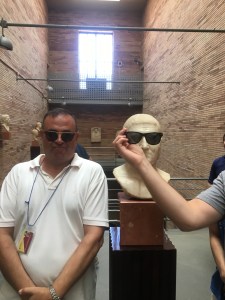
9/3: I had my first and last cup of coffee, and gained a good idea of what charcoal would taste like as well as respect for frequent coffee-drinkers. We drove 6 hours to the city of Grenada, a ride that taught me I need to stay out of prison because I could not handle solitary confinement. We visited a cathedral. I also saw this guy:IMG_0056

9/4: We drove to the city of Córdoba. This day was very hot. We visited a cathedral. (Noticing a pattern?) We then crashed in the city of Seville for the night, and I bungled my Spanish at Spala Imagen, the restaurant we ate at, and only ordered a tapa/appetizer. (FORESHADOWING!)

9/5: We toured Seville. Three guesses as to what we toured. Here they are: 1. a cathedral 2. a cathedral 3. a cathedral. We also passed by the Maestranza Bullring, which is a very historic bullring in Seville. This night was the night we discovered how freakin’ awesome the staff of our hostel was and the second night we ate at Spala Imagen. I ordered a plato this time.

9/6: A quick last walk through Seville, and on to the city of Mérida. We did not visit a cathedral; instead, we visited a Roman amphitheater that had been built while Spain was still Roman territory. I mustered a lot of self-control and did not yell “ARE YOU NOT ENTERTAINED?!?”, self-control that was for nothing because I will post it here:

I also got this picture of Enrique that made any downsides to Mérida worth it:

9/7: My first international birthday. Celebrations consisted of visiting a cathedral (yay?), my classmate Kennedy calling out “BIRTHDAY BOIIIIIIIIIIIIII!” at random intervals, eating chorizos at what I’m pretty sure was a Renaissance fair, getting a Punisher T-shirt at said Renaissance fair, and watching The Dark Knight with my friend Max in the room the two of us got to share. This day also marked the departure of Enrique. 😥

9/8: After a failed attempt to visit the castle the maybe-Renaissance fair took place outside of, we made our last stop in the mining town of Carucedo. The landscape could be compared to the red rock formations in the American Southwest:

The above picture is the roof of a cave that me and my classmates explored. Fears were faced as I made my way up a pretty sheer, sketchy path to the body of the cave. No pictures were taken, and I still have to wash all of the red dust out of that set of clothes. We then drove to a rest stop, I ate gas station steak (one commonality between US and Spain: gas station food is muy mal), and then drove to our home destination of Oviedo.

Which brings me to the last 48 hours.

The term “language barrier” is often thrown around when referring to people trying to communicate with different languages. The term is very accurate. Even in the first few minutes of meeting Elisa and José Villa, my host family, confusion ensued. I sat down in the backseat of their car and noticed a booster seat. I pored the deep corners of my brain, looking for the Spanish for “Do you have a grandchild?” I sagged a little as the Spanish eluded me.

The language barrier is a perfect way to describe the feeling: like you and the other person are on two sides of a thick concrete wall, and even though you yell at the top of your lungs, they only barely pick it up.

More frustrating are the moments of clarity followed by the relapse into confusion. This morning, I made it relatively smoothly through breakfast. I remembered the names of the food I ate, slipped on my house shoes when Elisa reminded me I wasn’t wearing them, and accepted a house key. OK, I’m improving. Then they asked if I was going out with my classmates. Uhhhh…crap.

The language barrier puts you in an odd place. I certainly don’t want to hide away from my host family–hey, thanks for letting me live here! Just gonna camp out in my room and only come out when I need my clothes washed!–but at the same time, how do you interact with people who you can only speak to in fragments?

I think Spain will be an adventure, but it will be an adventure with a rough start.

Un Hombre Estoy Muy Confundido,

Noah