The Hurt I Want

Several things happened in the span of a day. And these things made me think, of all things, of a freshman year party and puking in trash cans.

Flashback to freshman year. My roommate Mitch and my friend Max had back-to-back birthdays, Mitch’s birthday on April 6 and April 8. My friend group decided to celebrate with two nights of hanging out at Max’s house while Mama and Papa Max were away. Included in the festivities was “Reese,” a guy on our floor. We ended up regretting it.

Now, disclaimer: people change, and Reese is proof of that. I kept running into Reese throughout my college years, and I could see him growing as a person when I did. However, on these two nights, he was absolutely obnoxious. Full disclosure: people were drinking at Max’s house, Reese more than anybody. In the order I remember them happening: Mitch ended up putting Reese in a rear naked choke when Reese grabbed Mitch’s vape and ran; he came on super-creepily to one of Max’s high school friends when they were both in Max’s hot tub; and on the drive back to campus on Saturday night, it was only when we were halfway back that Reese realized he’d left his wallet at Max’s house. So, when we got back to campus and Reese tossed me his bag and ran to an outdoor trash can to vomit, my patience was at a low.

But, as I approached Reese, watched as he leaned over the trash bin and I heard the sound of regurgitated food hitting trash, I felt the strangest thing: affection.

I walked over to Reese, waited for him to throw everything up, handed him his bag when he was done, and we went inside.

Come back to the present, specifically last Friday (January 13). In the span of one morning, I learned that one of my coworkers is in the middle of extracting themself from a domestic violence situation. I learned that one of my students’ homes is currently being investigated by CPS, and that this student experienced serious academic regression due to one of their siblings getting murdered. And I learned that one of my students has been experiencing panic attacks, triggered by memories of a parent who died when they were in elementary school.

And the kicker? I can’t actually do much about any of these situations.

As much as I’d like to track down my coworker’s partner and see how much they like getting hit, a. I don’t know how I’d do that and b. somebody would be going to jail, and it’s not Jerkface. And as much as I’d like to point at my two students and say, “You’re coming home with me!” the law and the rules laid out to me in training say I can’t.

It hurts to care.

We live in a caring-averse society. We live in a world where Twitter tears apart a woman innocently Tweeting about how much she loves her morning routine. Where a quarter of surveyed people have ghosted potential romantic partners, and three-quarters of surveyed people think ghosting is a good way to end a relationship. Where a major news outlet like Salon hails the late David Foster Wallace as a prophet when he said irony is ruining our culture. Where award-winning rock band The 1975 have a song called “Sincerity is Scary”, with an accompanying music video that has 25 million views. Why is this the case? Why is irony the new black?

Because, to paraphrase the words of a certain clawed Canadian, “Bad things happen when we care about people.”

The question isn’t if caring about someone will hurt, the question is when. Friends will drop you for no good reason. Family members will break promises. People you look up to will have their character destroyed by a scandal. Partners will dump you out of nowhere, reveal an affair, abuse you or use your vulnerabilities against you.

And the hard truth? You have to accept it.

One of the most life-changing videos I’ve ever watched I first saw back in high school. It was a speech by V, FKA Eve Ensler, a feminist playwright and creator of The Vagina Monologues, where she talked about the war between freedom and security. While she was speaking in the context of politics and society (hello, PATRIOT Act and the Iraq War), the same can be said about relationships. You’re allowed to be emotionally closed off to your friends, your partners, your family members, your mentors, so long as you understand that emotional “security” comes at a cost: connection. In the same way that someone who makes their home into Fort Knox and never leaves has security at the cost of the freedom of living in the world, someone who locks away their emotions and vulnerabilities and never opens up or tries to get close to anyone has emotional security, but no emotional freedom.

After my lonely teenage years, a tough start to college, and the forced solitude of the pandemic, I thought I’d learned this lesson as much as I needed to. Then, I started working with kids.

At some point in late November or early December, I learned several of my students thought I was boring. At the very start of December, I flamed out. A day that was awful from start to finish had me ready to quit. Two of my mentors verbalized some thoughts I didn’t know I’d been having: that I had almost no connections in my school. I kept my distance from my coworkers, preferring the company of whatever book I was reading. I barely knew any staff aside from my partner teacher, and barely knew anything about most of my students–heck, I didn’t even know a lot of my students’ names! Latrell, my mentor, spelled it out for me: I wasn’t going to make it to the end of the school year unless I was willing to open up.

Latrell was right. I made that a goal when I came back from Christmas break, which is how I found out about my coworker’s situation and the background info about my students.

I want this pain.

Human existence has to have misery. No coping mechanism–no amount of money, no mind-altering substance, no amount of solitude or company, no religion, no political movement, nothing–can change the fact that at some point between being put in our mothers’ arms for the first time and being set at the bottom of a gravesite, we will experience hardship. So, we have a choice. We can endure those hardships with the additional hardship of a lack of emotional connection, or we can get down in the mud, connect our hurt to those stuck in the mud with us, and we can be broken together.

Back to “Reese” for the conclusion. I took him back to his room, made sure he was in bed, and then went back to my room and hopped on the Xbox. As my Call of Duty match started, I thought over the night. I focused in on helping Reese. It was a pain in the butt, having to do damage control for the stupid things Reese had done throughout the night. And yet, thinking about those couple of seconds where I’d helped Reese get the alcohol out of his system, all the trouble seemed…worth it. It was the seed, planted so it could bloom five years later as I returned to work.

It hurts to care about other people. To see my coworker cry as they spill the beans about their personal life. To hear a student say their parents don’t care what they do, no matter how dangerous. To watch my student’s face fall as they confess they’ve been obsessively thinking about their deceased parent.

But that kind of hurt, the kind you get by standing by someone when they’re at their lowest?

That’s the hurt I want.

Hopeless

Instagram recently solved a nagging question for me.

When you go to the Instagram search bar, pictures from accounts you may want to follow pop up. One day a few weeks ago, I clicked on a picture. It was one of those block-quote memes. You know the type, where someone quotes someone famous or a tweet for whatever political cause is on their mind.

Something like this.

The meme, whatever it was, appealed to my own morals, so I clicked the profile. And I found myself in a cesspool. This person, whose bio said they’re a theologian with a focus on feminist theology, was chock-full of dreary garbage. A lot of junk about “the Establishment” this and “free thinker” that and “state-affiliated propaganda.” Think of the stereotypes of the smug conspiracy theorist calling people sheeple and telling them to wake up, and that’s this person’s page.

As I scrolled through this page, I had a thought: This person is hopeless.

Let’s talk about that.

There are a couple definitions of the word “hopeless.” There’s hopeless as in incurable, i.e. “It’s hopeless to put her through chemo. The tumor’s too advanced.” There’s hopeless as in unable to improve, i.e. “Ted Mosby is a hopeless romantic.” There’s hopeless as in a situation that seems unwinnable, i.e. “The score was 38-68 with 10 seconds left on the clock. It looked hopeless for the Hornets.” There’s hopeless as in unable to be done, i.e. “The house is too damaged. Trying to flip it is hopeless.” I’m not talking about any of those definitions.

I’m talking about hopeless as in without hope.

So, what is hope?

Like its antonym, hope has several definitions. There’s hope as in wanting something to happen or for something to be true: “I hope the coffee shop isn’t too busy.” There’s hope as in expecting with confidence: “Your mother’s doing good, I hope.” There’s hope as in something or someone with a high rate of success: “Get Baker on offense. He’s our only hope.” There’s hope as in desiring a goal: “I’m hoping 2023 is a good year.” I’m not referring to any of these definitions. All of these definitions are based on uncertainty. I can hope my favorite coffee shop is slow and then walk in to find it wall to wall. Someone hoping for my mother’s well-being won’t cast a hedge of protection around her. A team using their star player doesn’t guarantee a win. And as the last two years have proven, all the well-wishes for a new year in the world has no effect on the outcome of the year.

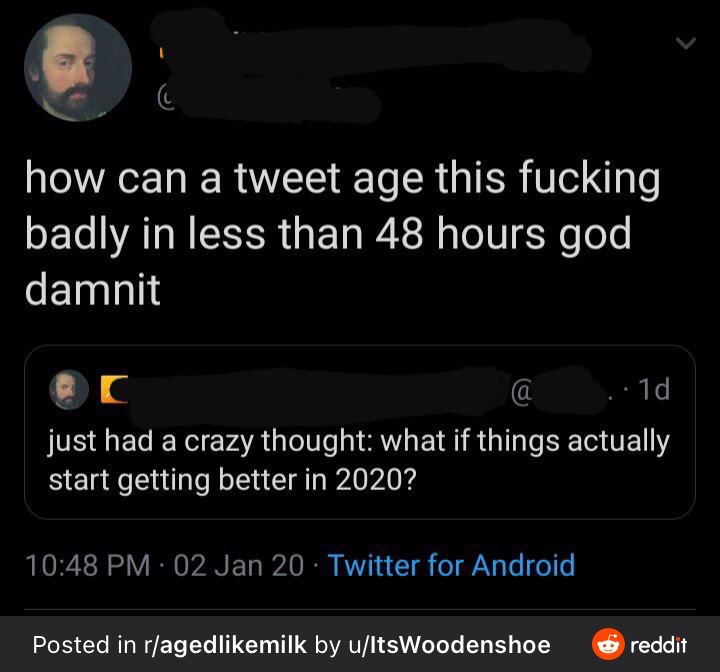
Can you spell “aged like milk”?

John Piper wrote a whole article on the type of hope I’m talking about. To quote from it directly:

…biblical hope is a confident expectation and desire for something good in the future. Biblical hope not only desires something good for the future — it expects it to happen. And it not only expects it to happen — it is confident that it will happen.

John Piper, “What is Hope?”

When I said that this person posting their memes about the Establishment and Obama being a war criminal was hopeless, that’s what I meant. Conspiracy theories–because let’s be real, that’s what this person is trafficking in–are inherently hopeless. Conspiracy theories give godlike power to human communities and institutions, be they the Jewish community, the rich, world governments, or the medical industry. Conspiracy theorists dress up their hopelessness with strands of truth, using the real instances of politicians’ lack of morality or the government rallying around the wealthy to convince people that X, Y and Z was a false flag operation or that George Soros is making the population dumber with chemtrails.

I feel like I’m getting off topic. Hopelessness.

There are a lot of hopeless Christians out there today, traditional and progressive. Under the traditional umbrella, you have the Christian doomsayers, the people who scream “Rapture!” at the drop of a hat. There’s also the sheer mess that is the religious right. January 6th is back on a lot of people’s minds with the congressional hearings starting this week, and I distinctly remember feeling deeply unsettled on January 6th as the news broke. The fact that anyone would attack the Capitol, let alone thousands of people, because they didn’t like the results of an election is scary enough, but it was what was in the crowd that disturbed me. Rioters carried crosses and Bibles, flew flags that said “Jesus 2020” and “Jesus is My Savior, Trump is My President” and some who broke into the Senate Chamber paused the vandalism to shoot God a thankful prayer.

Many an adjective has been hurled at the January 6 rioters: “violent,” “seditious,” “treasonous.” All of these adjectives make sense, but I’d throw one more adjective on the pile: “hopeless.” The people who stormed the Capitol had various reasons, but the supposed Jesus followers who picked up a gun or an axe handle did so because they had no Biblical hope. Even though they claim to believe in a holy book that says our Heavenly Father will rectify all wrongs and make a new heaven and a new earth, they may profess belief in this hope, but in their hearts they don’t believe it. They’ve been conditioned to believe that God can only work through certain people. (*cough*REPUBLICANS AND CONSERVATIVES!*cough*) And so when the enemy, those demon-possessed leftist Democrats, looks like they may have a shot at taking back the Oval Office, they’re not protesting, they’re firing the first shot of a holy war.

Hopelessness is also a problem in more progressive denominations, as Ms. Feminist Theologian Conspiracy Theorist above proved. (BTW, don’t hate on feminist theology because of this article. Feminist theology is a fascinating field, even if one person who studies it has a wack Instagram.) Although, I think progressive Christians can sometimes blunder into hopelessness rather than actively cultivating like the religious right does. Many progressive Christians are former fundamentalists, who fled the stuffy churches of their past and saw a more liberal denomination as a happy medium between the dead theologies they fled and atheism. But because there’s so many residual bad memories associated with religion, I think progressive Christians can focus too much on what they aren’t–the pack of judgmental hypocrites that Christians can prove themselves to be–rather than what they are: salt and light and God’s hands and feet until He returns.

And speaking of that, I need to make a disclaimer.

Up to this point, you may think my message is “Let go and let God.” NO. NO, IT IS NOT. Having encountered that line of thinking, I can say it’s nearly as noxious as those who say “God is a Republican” or Christian conspiracy theorists. I’m a firm believer that we as Christians are called to be people of action, to display radical love and make people see Jesus in us. I’m a part of the Assemblies of God, a Protestant denomination, so sainthood isn’t something I’m down with, but if sainthood was an aspect of Protestantism, I would want our saints to be Christians who took action. People like Martin Luther King, who paid for his divine calling to fight for black rights and labor laws with his life. People like Dietrich Bonhoeffer, a German theologian who refused to bend God’s Word to support the Third Reich and went to the gallows for being part of an assassination attempt against Adolf Hitler. People like Nelson Mandela, who sat in a jail cell for years for protesting South Africa’s apartheid laws and followed his Heavenly Father’s call to not only forgive his oppressors, but use his newly given power as President to lead South Africa into a nationwide reconciliation.

In fact, these people are prime examples of the power of Biblical hope. Many people think Martin Luther King knew, possibly through divine methods, possibly through being informed prior, that death was waiting for him in Memphis, Tennessee, based on certain things he said in his final speech, “I’ve Been to the Mountaintop.” If that is the case, the hope King had was so strong that he went to the metaphorical gallows with his head up, using his final hours to let others drink from his deep well of hope.

I’ve been going on and on about Biblical hope, so it feels appropriate to conclude by letting the Book itself have a say about hope:

I have told you these things, so that in me you may have peace. In this world you will have trouble. But take heart! I have overcome the world.

John 16:33, NIV

My I-Almost-Died-But-It-Was-Amazing Story

The most infuriating things in life are the things that are annoying, but necessary.

Take politics. I would try to put my opinions on the Democratic and Republican Parties into words, but said words would probably be quite vulgar and my parents read this blog. On the other hand, history has shown us the alternatives to a democracy, and they aren’t pretty. Or medical treatment. Multiple times a year, we have to go to different doctors to have them examine our eyes, our teeth, our—OK, you get the point. But what’s the alternative? Going blind? Having three teeth in our heads? Rectal cancer?

Perhaps the first and foremost necessary evil? Fear.

I have a unique relationship with social anxiety. Performances and public speaking, I have almost no problem with. I’ve recited poems, sang, preached, and spoke to audiences with no problem–in fact, I’ve rather enjoyed the experiences. It’s experiences out of the spotlight that make me tense up. I went to prom with a good measure of reluctance and spent the entire time I was on the dance floor thinking, Don’t look stupid. Don’t look stupid. This day-to-day anxiety combines with that widespread millennial affliction known as FOMO, or Fear Of Missing Out. I sit on the sidelines, observing other people my age acting like socially-healthy 18-25-year-olds and think, I’d like that. My decision to apply for a semester abroad was, in fact, largely an attempt to combat some of this melting pot of “Dear God, I’m a freak of nature and I’m probably going to die alone”. I told myself I was already getting out of my comfort zone, so I could stand to tread some unfamiliar water.

This Past Weekend Me cursed that thought as he tried to not plunge to his death and/or severe ouchies.

Saturday, I went out to a beach in a city called Aviles. I say beach, but there were two: one big one that we ended the day at and a smaller, rockier one that we started the day at. In between those two, my group found a staircase that led down to a natural rock shelf. Next to that was a “””””””””path”””””””””””” that could be walked over to a pebble beach with a cave. My friends Tanner and Benji immediately beelined for the “”””””””path”””””””””. Me? I was a little more reluctant. I looked at the “””””””””””path””””””””””, then at the crashing water below it and the big, unforgiving rocks they were crashing against, the rocks I would land on were I to lose my footing. Finally, I took a deep breath. I came here to get out of my comfort zone, I thought and started the trek.

Oh, dear Lord, why did I do this?!?

The reason I have “”””””””path””””””””””””” in so many quotations is because it was less a path and more chunks eroded out of the rock that a person with good balance could use to walk to the pebble beach. Every chance glance anywhere but forward made the possibility of being shipped back to the States with my bones reduced to gravel seem more real. My legs turned to jelly when I dropped to the beach. Hyperventilating with relief, I walked over to the cave.

It was a half-circle, maybe 8 feet deep, and the other entrance led out into the ocean.

Are you [my parents read this blog]ing kidding me?

I took a few pictures and prepped myself for the climb back. Tanner noticed my apprehension and pointed out another path. It was less of a straight shot, but had vegetation and fewer death rocks. I [foolishly] agreed to take it.

It was only after we were past the point of no return that we realized our mistake. The “”””””””””””””””””””””””””””””””””””””””””””””””””””””path””””””””””””””””””””””””””””””””””””””””””””””” might have been carved out by lizards a few decades ago. The footing was just as treacherous as the way over, if not more so, and the vegetation I thought would serve as an anchor/safety net was thorny and unforgiving. With much struggle, me and Tanner made our way up the cliff. The top of the cliff was getting closer and closer. And then a problem arose.

What would have been my ticket out of needing a new pair of pants sloped into a near-vertical cliff. Tanner tried and failed to climb it. He slid back down to me and pointed out another way: another lizard-forged path straight through the thornbushes below us that we could make our way through that led to a lower cliff. I preemptively said goodbye to my future children and lowered myself into the bushes.

Several minutes, several mental cries for my mother, and one boost later, me and Tanner stood at the top of the cliff, admiring the view. Tanner asked one of those classically American “how you doing, dude?” type questions. I took that opportunity to launch into an anecdote I’d read in the book Wild at Heart, about a Southern judge who sailed as a hobby and considered his near-death in a tropical storm to be the highlight of his life. I concluded, “Someday, this may be my crazy almost-died-but-it-was-great story.” I paused to steady my shaking legs and then added, “But not today!”

So what to draw from this experience? Fear, at its base, is like a gun–while it’s meant for self-preservation, too easily and too often it can be perverted, being corrupted into anxiety, paranoia, or even clinical disorders like depression or a phobia. At the end of the day, the only things you can do are let the fear stay or turn and fight. As the old saying goes, “there’s nothing to fear but fear itself.”

El Hombre Que Casi Un Ataque Al Corazón, 

Noah