Hopeless

Instagram recently solved a nagging question for me.

When you go to the Instagram search bar, pictures from accounts you may want to follow pop up. One day a few weeks ago, I clicked on a picture. It was one of those block-quote memes. You know the type, where someone quotes someone famous or a tweet for whatever political cause is on their mind.

Something like this.

The meme, whatever it was, appealed to my own morals, so I clicked the profile. And I found myself in a cesspool. This person, whose bio said they’re a theologian with a focus on feminist theology, was chock-full of dreary garbage. A lot of junk about “the Establishment” this and “free thinker” that and “state-affiliated propaganda.” Think of the stereotypes of the smug conspiracy theorist calling people sheeple and telling them to wake up, and that’s this person’s page.

As I scrolled through this page, I had a thought: This person is hopeless.

Let’s talk about that.

There are a couple definitions of the word “hopeless.” There’s hopeless as in incurable, i.e. “It’s hopeless to put her through chemo. The tumor’s too advanced.” There’s hopeless as in unable to improve, i.e. “Ted Mosby is a hopeless romantic.” There’s hopeless as in a situation that seems unwinnable, i.e. “The score was 38-68 with 10 seconds left on the clock. It looked hopeless for the Hornets.” There’s hopeless as in unable to be done, i.e. “The house is too damaged. Trying to flip it is hopeless.” I’m not talking about any of those definitions.

I’m talking about hopeless as in without hope.

So, what is hope?

Like its antonym, hope has several definitions. There’s hope as in wanting something to happen or for something to be true: “I hope the coffee shop isn’t too busy.” There’s hope as in expecting with confidence: “Your mother’s doing good, I hope.” There’s hope as in something or someone with a high rate of success: “Get Baker on offense. He’s our only hope.” There’s hope as in desiring a goal: “I’m hoping 2023 is a good year.” I’m not referring to any of these definitions. All of these definitions are based on uncertainty. I can hope my favorite coffee shop is slow and then walk in to find it wall to wall. Someone hoping for my mother’s well-being won’t cast a hedge of protection around her. A team using their star player doesn’t guarantee a win. And as the last two years have proven, all the well-wishes for a new year in the world has no effect on the outcome of the year.
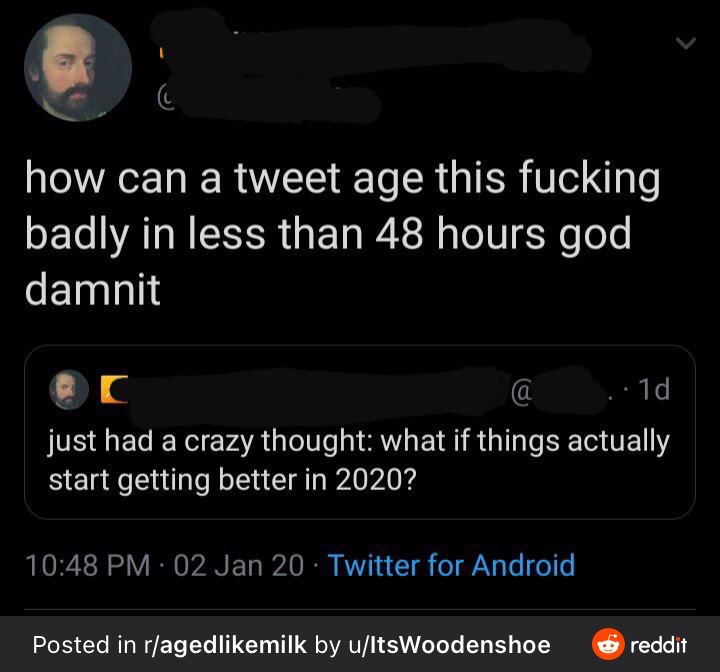
Can you spell “aged like milk”?

John Piper wrote a whole article on the type of hope I’m talking about. To quote from it directly:

…biblical hope is a confident expectation and desire for something good in the future. Biblical hope not only desires something good for the future — it expects it to happen. And it not only expects it to happen — it is confident that it will happen.

John Piper, “What is Hope?”

When I said that this person posting their memes about the Establishment and Obama being a war criminal was hopeless, that’s what I meant. Conspiracy theories–because let’s be real, that’s what this person is trafficking in–are inherently hopeless. Conspiracy theories give godlike power to human communities and institutions, be they the Jewish community, the rich, world governments, or the medical industry. Conspiracy theorists dress up their hopelessness with strands of truth, using the real instances of politicians’ lack of morality or the government rallying around the wealthy to convince people that X, Y and Z was a false flag operation or that George Soros is making the population dumber with chemtrails.

I feel like I’m getting off topic. Hopelessness.

There are a lot of hopeless Christians out there today, traditional and progressive. Under the traditional umbrella, you have the Christian doomsayers, the people who scream “Rapture!” at the drop of a hat. There’s also the sheer mess that is the religious right. January 6th is back on a lot of people’s minds with the congressional hearings starting this week, and I distinctly remember feeling deeply unsettled on January 6th as the news broke. The fact that anyone would attack the Capitol, let alone thousands of people, because they didn’t like the results of an election is scary enough, but it was what was in the crowd that disturbed me. Rioters carried crosses and Bibles, flew flags that said “Jesus 2020” and “Jesus is My Savior, Trump is My President” and some who broke into the Senate Chamber paused the vandalism to shoot God a thankful prayer.

Many an adjective has been hurled at the January 6 rioters: “violent,” “seditious,” “treasonous.” All of these adjectives make sense, but I’d throw one more adjective on the pile: “hopeless.” The people who stormed the Capitol had various reasons, but the supposed Jesus followers who picked up a gun or an axe handle did so because they had no Biblical hope. Even though they claim to believe in a holy book that says our Heavenly Father will rectify all wrongs and make a new heaven and a new earth, they may profess belief in this hope, but in their hearts they don’t believe it. They’ve been conditioned to believe that God can only work through certain people. (*cough*REPUBLICANS AND CONSERVATIVES!*cough*) And so when the enemy, those demon-possessed leftist Democrats, looks like they may have a shot at taking back the Oval Office, they’re not protesting, they’re firing the first shot of a holy war.

Hopelessness is also a problem in more progressive denominations, as Ms. Feminist Theologian Conspiracy Theorist above proved. (BTW, don’t hate on feminist theology because of this article. Feminist theology is a fascinating field, even if one person who studies it has a wack Instagram.) Although, I think progressive Christians can sometimes blunder into hopelessness rather than actively cultivating like the religious right does. Many progressive Christians are former fundamentalists, who fled the stuffy churches of their past and saw a more liberal denomination as a happy medium between the dead theologies they fled and atheism. But because there’s so many residual bad memories associated with religion, I think progressive Christians can focus too much on what they aren’t–the pack of judgmental hypocrites that Christians can prove themselves to be–rather than what they are: salt and light and God’s hands and feet until He returns.

And speaking of that, I need to make a disclaimer.

Up to this point, you may think my message is “Let go and let God.” NO. NO, IT IS NOT. Having encountered that line of thinking, I can say it’s nearly as noxious as those who say “God is a Republican” or Christian conspiracy theorists. I’m a firm believer that we as Christians are called to be people of action, to display radical love and make people see Jesus in us. I’m a part of the Assemblies of God, a Protestant denomination, so sainthood isn’t something I’m down with, but if sainthood was an aspect of Protestantism, I would want our saints to be Christians who took action. People like Martin Luther King, who paid for his divine calling to fight for black rights and labor laws with his life. People like Dietrich Bonhoeffer, a German theologian who refused to bend God’s Word to support the Third Reich and went to the gallows for being part of an assassination attempt against Adolf Hitler. People like Nelson Mandela, who sat in a jail cell for years for protesting South Africa’s apartheid laws and followed his Heavenly Father’s call to not only forgive his oppressors, but use his newly given power as President to lead South Africa into a nationwide reconciliation.

In fact, these people are prime examples of the power of Biblical hope. Many people think Martin Luther King knew, possibly through divine methods, possibly through being informed prior, that death was waiting for him in Memphis, Tennessee, based on certain things he said in his final speech, “I’ve Been to the Mountaintop.” If that is the case, the hope King had was so strong that he went to the metaphorical gallows with his head up, using his final hours to let others drink from his deep well of hope.

I’ve been going on and on about Biblical hope, so it feels appropriate to conclude by letting the Book itself have a say about hope:

I have told you these things, so that in me you may have peace. In this world you will have trouble. But take heart! I have overcome the world.

John 16:33, NIV

TIWTTA: Great Replacement Theory

Today I want to talk about the Great Replacement Theory.

Welcome back, everyone, to Today I Want to Talk About…(TIWTTA), a series on this blog where I dissect a hot-button topic.

And today’s topic is hot.

On May 14, a pile of human garbage I won’t name here drove about 200 miles from Conklin, New York, to Buffalo, New York. He entered a Tops Friendly Market in the predominantly black Kingsley neighborhood wearing body armor and wielding an AR-15. He shot thirteen people, killing ten, before coming out of the store and surrendering to police. He also livestreamed the whole thing on Twitch, in case you thought there was anything sympathetic about this sewer dredge.

Police didn’t have to look far to find his motivation. All over his weapons, the bag of cat diarrhea in a bulletproof vest had written the names of other human cockroaches who had killed for racially motivated reasons, and excerpts from manifestos some of these wastes of space had written. He also etched various racist terms and white supremacist symbols on his gear. And speaking of manifestos, the police found a 180-page manifesto written in Google Docs. A search of the human hot dog water’s computer found posts on Discord and 4chan, as well as an online diary where he planned the attack, revealed incriminating information that tied the accounts to the shooter, and where the puke stain with a trigger finger ranted about today’s subject: The Great Replacement.

What is the Great Replacement Theory?

The Great Replacement is a white supremacist conspiracy theory. It alleges that immigrants from nonwhite countries are coming to Western countries with the goal of destroying the white race, either through interracial marriage or through an influx of black and brown people making white people the minority in Western countries.

The National Immigration Forum, an advocacy organization based in Washington DC, noted there are three iterations of Great Replacement Theory in an article on the topic. They are:

  • Rhetoric of invasion: this version of Great Replacement paints the Replacement as a hostile takeover, the worst of neighboring societies sneaking across borders that can only be stopped with a hardline immigration policy, the halting of immigration altogether, or violence.
  • Voter replacement: this version of Great Replacement says that the reason for the replacement is political, that these immigrants are here to sway political power. Since Great Replacement is a far-right conspiracy theory, this strain of Great Replacement fallaciously assumes that immigrants are guaranteed to vote for left-wing parties.
  • Antisemitism: Since spouting a conspiracy theory that white people are such the center of the universe that the continents of Africa, Asia and South America conspire together to send immigrants to predominantly white countries to copulate the white race out of existence isn’t racist enough, how about some good old antisemitism? Yes, the third and final strain of Great Replacement is closely tied to the international Jewish conspiracy, saying that the Jews who control the world from behind the scenes are sending immigrants to Western countries en masse because…reasons.

Who’s Responsible for the Great Replacement Theory?

There are several people you could consider “responsible” for Great Replacement Theory.

If you’re talking in terms of invention, that “””””””””honor”””””””” goes to Jean Raspail, a French author. In 1973, he wrote Les Camp de Saints, translated into English as The Camp of the Saints. This dystopian novel depicts the slow destruction of Western civilization via mass immigration from countries of the Global South. The book is revered in white supremacist circles.

If you’re talking about who named the conspiracy, that “””””””””””honor”””””””””” goes to Renaud Camus, another French writer. His 2011 book Le Grand Remplacement (The Great Replacement) theorized that “replacist elites” were colluding to take advantage of declining birth rates in Europe to flood Europe with African and Middle Eastern immigrants.

If you’re talking who popularized the theory, look to former Iowa Representative Steve King, French presidential candidate Marine Le Pen, and contender for the most punchable face on the planet Tucker Carlson. In 2017, Steve King tweeted, “We can’t restore our civilization with someone else’s babies.” In 2019, Marine Le Pen referenced Great Replacement. (Link leads to a French-language article.) And The New York Times published two articles focusing on how Tucker Carlson both promoted Great Replacement ideas and emboldened other conservative figures to promote similar ideas. And while Tucker is the main promoter at Fox News, he’s not the only one: Laura Ingraham and Jeanine Pirro have both used Great Replacement rhetoric in their programs on Fox News.

What Have Been the Consequences of Great Replacement?

The crux of this post is an act of violence fueled by the Great Replacement Theory. However, the violence in Buffalo is far from the first time someone picked up a weapon in the name of keeping the white race from being overrun.

On August 11, 2017, hundreds of white supremacists gathered in Charlottesville, Virginia, for an event called “Unite the Right.” The white supremacists marched while chanting slogans like “You will not replace us” and “Jews will not replace us.” (Sound familiar?) Counter-protests sprung up, and the event came to a horrific end when a man drove a car through a gathered crowd, killing counter-protestor Heather Heyer.

On October 27, 2018, another human trash heap attacked the Tree of Life synagogue in Pittsburgh, Pennsylvania. He shot and killed 11 Jewish people attending a service and injured another 6. Much like He-Who-Will-Not-Be-Named-Buffalo-Edition, the perpetrator’s Internet footprint showed he frequented white supremacist forums and believed in white genocide, a conspiracy theory closely tied to Great Replacement theory. Police found the shooter’s motive amongst the rambling about Jews: that the Hebrew Immigrant Aid Society (HIAS) was funneling Central American migrants into the US to kill white people.

On March 15, 2019, a man attacked two mosques in New Zealand. 51 people were killed in the attacks. In a pattern that should be familiar by now, the shooter left a manifesto literally titled “The Great Replacement.” It was usual white supremacist fare: fearmongering and racism against immigrants, praising prior violence against Muslims, and exalting other mass shooters.

On August 23, 2019, a white man drove 650 miles from the Dallas/Fort Worth area to El Paso, Texas. He opened fire inside of a Walmart with an AK-47 rifle, killing 23 and injuring 23. Police found a manifesto titled “The Inconvenient Truth” published on the white supremacist haven site 8chan. The writer expressed his belief in a “Hispanic invasion” of the United States and his hope that the violence he rained down on the Hispanic population of El Paso would deter Hispanic people from coming to America.

We must also consider the use of Great Replacement Theory dogwhistles. While few conservative figures have expressed full-on support for Great Replacement Theory, many of them, including former President Donald Trump, Turning Point USA’s Charlie Kirk, and Florida Representative Matt Gaetz, have echoed tenets of Great Replacement Theory.

What Can We Do to Fight Great Replacement Theory?

Ultimately, it’s up to our lawmakers to put an end to mass shootings. Anti-domestic terrorism laws, stricter gun control laws, and smarter approaches to tracking firearms have been the key to the low rates of gun violence in other countries, and that legislation can only be passed by Congress. But, there are things we the citizens can do to fight the influence of Great Replacement Theory ideas:

  • Don’t name mass shooters. I’ve been routinely using insults in place of names throughout this post. Partly, it’s to provide some levity in a post about a very unfunny subject, but I’m also doing it for a good reason: it denies what these killers want, fame. In an article for the National Catholic Reporter, Adam Lankford, a criminal justice professor from the University of Alabama, said that the way media covers mass shooters, and especially how they name the shooter and shine a light on their backgrounds, can embolden other potential shooters. We can see this in the above cases, where the shooters in Great Replacement-fueled violence named other terrorists with similar causes in their motivations. By leaving the shooters nameless, these killers are robbed of the gratification of fame through violence, the chances of copycat crimes go down dramatically, and the focus goes back to where it belongs, the victims.
  • Amplify voices speaking against Great Replacement Theory. Specifically, conservative voices who have spoken against Great Replacement rhetoric. They might feel hard to find, but they exist. The increasingly radical turn of American conservatism means that condemnation of Great Replacement Theory from the left will not only be ineffective, it might actually make it more popular in conservative politics. I can give you at least two people to fall back on. Linda Chavez, who headed the US Commission on Civil Rights during the Reagan Administration, condemned Great Replacement Theory during an episode of MSNBC’s All In with Chris Hayes. Following the death of Heather Heyer, former Presidents George H.W. Bush and George W. Bush condemned the Unite the Right rally and the racism that motivated it. Introducing dissenting opinions into the echo chamber is one way to get a real discourse going.
  • Use the Socratic method. However its proponents try to spin it, the Great Replacement is a conspiracy theory, a racist yarn spun by white supremacists and their sympathizers who are terrified of the consequences they could face if they ever lost their white privilege. Because of this, Great Replacement can’t stand up to critical thought. So if you ever hear someone spewing Great Replacement rhetoric, you can poke holes in their arguments by asking questions like:
    • What’s so bad about more immigrants coming to America? The colonists were immigrants. Were they bad?
    • If immigrants are freeloaders, why do immigrants make up a bigger percentage of the US population than the native-born population? (Source)
    • How are you so certain immigrants will vote Democrat? If that’s the case, why did a survey find that 23% of undocumented immigrants either identify as Republican or right-leaning? (Source)
    • (specifically if they mention Tucker Carlson) You know a judge ruled that Tucker Carlson’s show is a crock pot of misinformation, right? (Source)
    • You’re scared of white people becoming the minority? Why? Are minorities treated badly? (There’s no source–I got that one from a TikTok audio.)
  • Support immigrants. Even if Great Replacement doesn’t cause violence, it can sow the seeds for it by encouraging anti-immigrant rhetoric. So support immigrants. Make immigrants in your community feel welcome or volunteer with organizations that help immigrants. Show your support for pro-immigrant legislation.

The state of the government today, with many politicians being bankrolled by the NRA and gun companies, means that better gun control laws might not be passed in our time. But we’re not helpless. We can tear Great Replacement to shreds, expose it for the racist and nativist crock of lies it is. We can inexorably tie its ideas to such horrific violence as the 10 people killed in Buffalo. We can deny Great Replacement-motivated terrorists the infamy they load a gun to gain.

Change? In this country? It’s not impossible.