
Today I want to talk about critical race theory.
Welcome back everyone. TIWTTA is a series on this site where I take a current issue and cut through the bullcrap. I did one of these about privilege back in 2020 and then never again. Until now, that is!
Other than Ukraine, there might not be a hotter button topic than critical race theory. And the discourse around it (especially in right-wing spaces) makes it clear a lot of people are being misled. So, a solid definition is a good place to start.
What Is Critical Race Theory?
The simplest definition of critical race theory I could find comes from an Education Week article on the topic: “Critical race theory is an academic concept that is more than 40 years old. The core idea is that race is a social construct, and that racism is not merely the product of individual bias or prejudice, but also something embedded in legal systems and policies.” Key to critical race theory is the concept of systemic racism, defined by The Aspen Institute as “a system in which public policies, institutional practices, cultural representations, and other norms work in various, often reinforcing ways to perpetuate racial group inequity.”
I’ll use Education Week’s example of redlining for an example of critical race theory’s application. Redlining was a governmental practice in the 1930s. Lawmakers would hang up city maps and draw red outlines (hence the name) around neighborhoods they saw as financial risks. Most of these neighborhoods were “risky” because they had majority-black populations. They would pass these maps on to banks, who would then refuse mortgages and loans to residents of “risky” neighborhoods who applied for a mortgage in a “safer” neighborhood, effectively trapping black Americans in these “risky” neighborhoods. Though redlining was outlawed by the 1968 Fair Housing Act, it continues to affect American society to this day. The redlined neighborhoods of yesterday have become the projects and low-income neighborhoods of today. The practice of redlining effectively created the cycle of poverty in the US. Because of the state of these neighborhoods, businesses and community improvement opportunities go elsewhere, keeping these communities in their broken-down state due to lack of resources. Since home ownership is a major financial stabilizer, the disparity between black and white homeowners has also contributed to the wealth gap between black and white people. And because many of the residents in these neighborhoods turn to crime because they have no other options, redlining is also directly responsible for racist ‘tough on crime’ political rhetoric and policing practices.
So: because of a social construct (stereotypes of financial irresponsibility and delinquency wrongly attributed to people because of their skin color) a system (redlining) of public policies (housing discrimination), institutional practices (refusing financial help to black folks looking to buy homes) and cultural representations (black people are lesser and your neighborhoods will suffer if you let them in) perpetuate racial group inequity (the cycle of poverty and discrepancies between the number of white and black homeowners) and also leave behind nasty legal traps long after the system is “abolished” (joblessness, racist policing, “tough on crime” politics).
You picking up what I’m putting down?
Who Created Critical Race Theory?
Eight different figures are considered the “founders” of critical race theory. They all contributed an idea critical (heh) to the school of thought. They are:
- Derrick Bell (1930-2011), a civil rights lawyer, Harvard professor, and author, got the ball rolling by introducing the idea of interest convergence. Interest convergence is the idea that black people achieve civil rights victories only when black and white interests converge. Bell argued that Brown v. Board of Education was ruled in Brown’s favor because a desegregated America would have a better time winning allies in the Cold War.
- Charles R. Lawrence III (1943-), an attorney, researcher, educator, and law professor at Georgetown University, focused on the idea of unconscious racism. He defined racism as “a set of beliefs whereby we irrationally attach significance to something called race” and pointed out that, by this definition, all people are racist. It is this type of unconscious racism, as opposed to the overt racism displayed by white supremacists, that plagues the white moderates Martin Luther King Jr. vehemently criticized in his “Letter from a Birmingham Jail.”
- Kimberlé Williams Crenshaw (1959-), a civil rights activist, scholar, and professor at UCLA and Columbia University, coined the phrase retrenchment. Retrenchment states that white supremacists will always move the goalposts, or retrench, when it comes to proving the superiority of whites over other races. When scientific racism was exposed as pseudoscience, white supremacists focused on the superiority of white cultures. And Crenshaw came up with the idea during the Reagan-era attacks on affirmative action, the next stage of retrenchment when cultural racism faltered. (Today’s attacks on critical race theory are themselves examples of retrenchment.)
- Richard Delgado (1939-), a legal scholar who teaches at the University of Alabama School of Law, literally wrote the book on CRT. He is also one of the founders of LatCrit, an offshoot of critical race theory that takes its principles and applies it to the treatment of Latin Americans in US society.
- Alan David Freeman (1943-1995), a law professor at University at Buffalo Law School, worked with Derrick Bell in the early days of Bell developing critical race theory. Freeman promoted a new paradigm of the law. Law, in Freeman’s eyes, was “an evolving statement of acceptable public morality” that’s primary purpose is to “legitimize the existing social structure and, especially, class relationships within that structure.” (In layman’s terms, if you’ve ever seen this meme or something similar to it, the idea comes from Alan David Freeman’s legal theories.) Freeman’s ideas are key to wrapping your head around the idea of systemic racism.
- Cheryl I. Harris (???-), faculty director for the Critical Race Studies program at the UCLA School at Law, wrote the 1993 article “Whiteness as Property.” The paper itself is 85 pages long, so a summary: white identity and property are deeply interrelated concepts. Because property is so deeply tied to whiteness, laws that protect property often work to elevate white society. (She’s also Earl Sweatshirt’s mother, so even if the paper’s not your speed, that’s cool, innit?)
- Mari Matsuda (1956-), a lawyer, activist and law professor in the University of Hawaii’s William S. Richardson School of Law, made a name for herself with her 1986 article “Liberal Jurisprudence and Abstracted Visions of Human Nature.” Her paper provided a feminist critique of John Rawls’ theory of justice, and concluded with the idea relevant to this post: that to achieve the society of free equals Rawls idealized in his philosophy, outsider voices and communities must have a place in the law.
- Patricia J. Williams (1951-), a legal scholar, contributor to The Nation and director of law, technology and ethics at Northeastern University, has been the publicist of critical race theory, discussing it in her The Nation column “Diary of a Mad Law Professor” and having written for The New York Times on the topic of CRT.
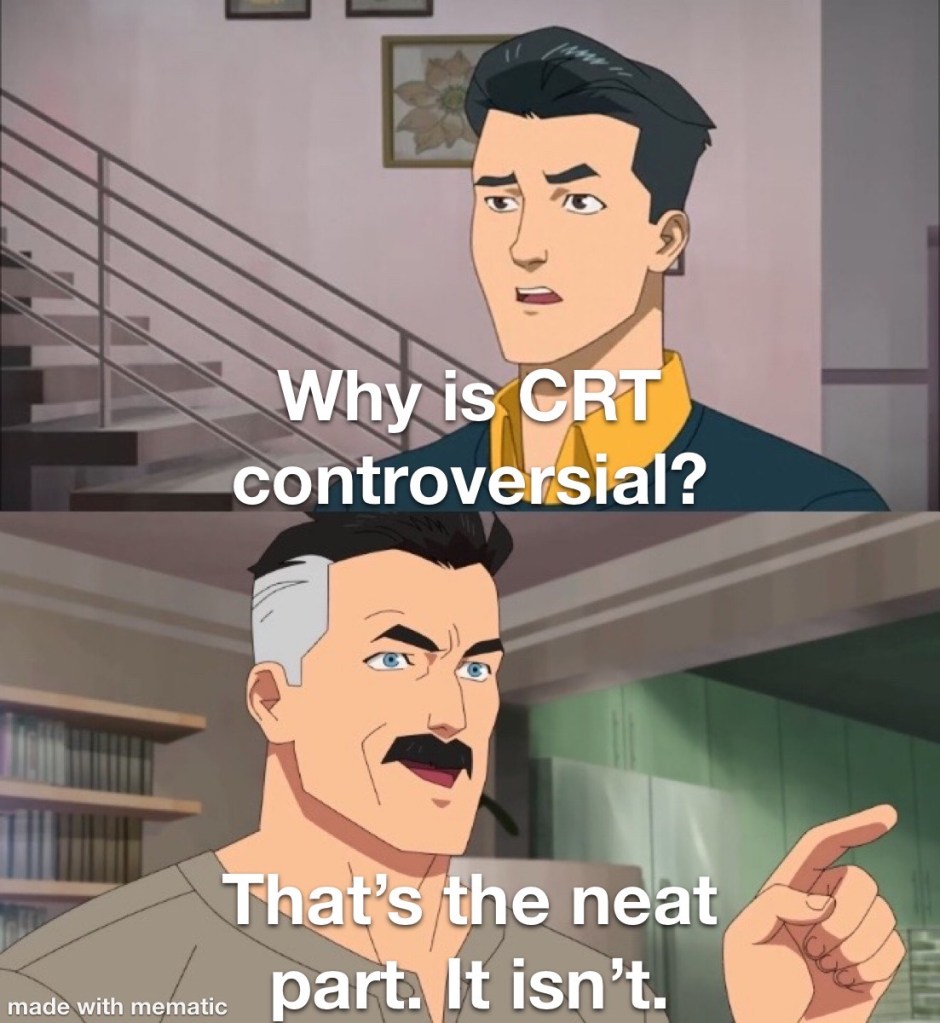
Remember that retrenchment idea Kimberlé Crenshaw came up with? The backlash against “critical race theory” is an example of retrenchment. If you found yourself reading about the founders of CRT and thinking everything they’re talking about sounds way too lofty for elementary schoolers and/or noticed all the founders of CRT are some kind of professor, legal scholar, or lawyer, CONGRATULATIONS! You have done more critical thinking than everyone who’s screamed at school board members for brainwashing their children combined.
Critical race theory–the actual field of study, which is exclusively a grad school-level subject–isn’t what Fox News mentioned 1300 times in a year or what politicians are coasting into office by promising to fight. You can tell because of the many laws on the books cracking down on “critical race theory,” (more on that in a minute) none have a consistent definition of “critical race theory.” Aziz Huq, a lawyer and law professor at the University of Chicago Law School, noted these inconsistencies in his TIME article “The Conservative Case Against Banning Critical Race Theory.” Is it “racial essentialism,” like the Republican Study Committee said in a newsletter? Is it a Marxist scheme defining race as a social construct to stick it to white men, like Ellie Krasne of the Heritage Foundation thinks? Is it identity-based Marxism meant to gear the US government towards a socialist revolution, like Christopher Rufo of the Manhattan Institute believes? Is it emphasizing race over character, as Florida Governor Ron DeSantis contended when he passed the Stop W.O.K.E. Act into law? Is it an especially inflammatory form of identity politics, like Idaho lawmakers said when they passed HB 377?
It’s none of these things, and the people making a stink know it. This uprising is a power play.
One of the oldest tricks in the right-wing playbook is conflation. If you don’t know what I mean, consider this meme:
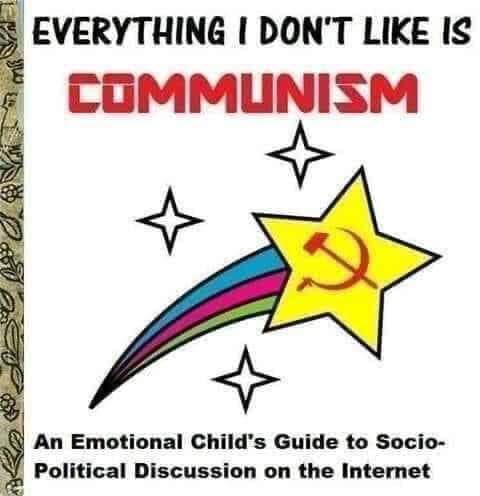
It’s a satire of real Internet discourse. Even though communism is an economic system (read: communists are most focused on work- and economics-related issues like labor unions, livable wages and wealth equity) conservatives scream “communism” at any left-wing policy, even on issues that communists would logically have little interest in, like gun laws or climate change. By instilling such a rabid hatred of communism in their voters, conservative lawmakers can turn their voter base against virtually anything proposed by liberals. And that’s the idea with the sudden revolt against CRT. First, label anything having to do with race and academics–diversity, inclusion, and equity efforts, affirmative action, curriculum content, etc.–as CRT. Second, throw in misinformation and false equivalencies meant to stir up white fragility and/or make the counter-protestors look like the bad guys, like: critical race theory teaches our kids that discrimination against white people is OK. And besides, it’s demeaning to black people, teaching them that they’re victims. It’s going to make American education worse, and make white students uncomfortable while doing it. Step three: trot out the anti-CRT measures and profit.
As a matter of fact, Republican politicians already are. Fresh off the success of the Stop W.O.K.E. Act, Ron DeSantis passed HB 1557, informally known as the “Don’t Say Gay” Bill, applying the anti-“CRT” veto to curriculum related to LGBTQ+ history and social issues. Texas lawmakers are trying to pass an identical law. And, likely emboldened by the success of the nationwide smear campaign against “critical race theory,” an onslaught of laws targeting LGBTQ+ rights (with emphasis on the T) have been proposed nationwide since January of 2022.
Where Is This Happening?
The short answer: red states. The long answer can be found in the Forbes article “Teacher Anti-CRT Bills Coast to Coast: A State-by-State Guide.” Some highlights:
- Arizona has an anti-“CRT” law in place for state agencies and, as of February 16, had two bills in gestation forbidding “CRT” from Arizona schools and one forbidding affirming ideas about race.
- I’ve already mentioned Florida extensively, but believe it or not, it gets worse. Along with the Stop W.O.K.E. Act and the “Don’t Say Gay” Bill, SBs 242 and 148 aim to remove, quote, “anything that makes students feel ‘discomfort, guilt, anguish or any other form of psychological distress'” from classroom settings. Ron DeSantis is also pushing for parents to be able to sue teachers that teach curriculum they disagree with.
- It’s a bad time to be a teacher in a state that starts with “I.”
- Idaho was one of the first states to pass an anti-“CRT” law. Idaho lawmakers are in lockstep with Ron DeSantis in fighting for parents’ rights to sue teachers over teaching ideas they object to.
- Indiana senator Scott Baldwin made national headlines by demanding teachers be impartial when discussing Nazism and fascism in classrooms. His saying the quiet part out loud sunk that particular bill, but four others–SB 415 and HBs 1362, 1389 and 1134–sprung up in its place. These bills would ban gender and race diversity training and would allow school funding to be pulled if staff didn’t comply.
- Iowa passed HF 802 in spring 2021, banning “racial and sexual stereotyping” in diversity training (read: they disallowed discussion of implicit bias, a foundational concept in diversity training, from diversity training.) Four bills are pending. One forbids negative comments about the Pledge of Allegiance. Another demands teachers take a Baldwinesque “balanced” approach to controversial topics.
- In the land of McConnell-induced hell, aka Kentucky, four bills would ban gender/diversity training, discussion of certain topics, and would mandate versions to teach a specific version of American history. Teachers could have their credentials revoked should they disobey the bills.
- Missouri takes the cake with a whopping sixteen bills promoting standard anti-“CRT” fare: ban on “divisive” concepts, a mandated positive presentation of US history, and a requirement of signing a “non-indoctrination clause,” wherein a teacher must teach all sides of political, religious or ideological debates.
- New Hampshire must have something in the state drinking water, because along with a bill on the books that would forbid mentions of Marxism, socialism and negative portrayals of the Founding Fathers in classroom discussion, the New Hampshire branch of Moms for Lying to Children–I mean, Liberty–is offering bounties to report rule-breaking teachers.
- In second place for volume behind Missouri is Oklahoma, with nine bills extending the reach of an established anti-“CRT” law in the pipeline. These bills, along with standard anti-“CRT” fare, would ban certain flags from the classroom, disallow teachers from giving extra credit for political activity, and would allow parents to sue teachers for contradicting religious beliefs.
- Tennessee was one of the states where the critical race theory panic began. Five anti-“CRT” bills are in the pipeline. One of them is Tennessee’s own “Don’t Say Gay” Bill.
- One of Virginia governor Glenn Youngkin’s first actions in office was to make good on his campaign promise and sign an anti-“CRT” executive order. Five bills supporting the executive order are in the pipeline. They also forbid teachings that criticize capitalism and have a built-in bathroom bill.
- In third place for who’s taken the most crazy pills is West Virginia, with seven anti-“CRT” bills in the pipeline. One forbids the discussion of certain topics like communism, critical economic theory, Maoism or Marxism unless, quote, “the teacher includes ‘the scope and scale of state sponsored terror and murder, absence of legal process and protection of civil and political rights, forced labor, economic inefficiency and starvations’ that came with such philosophies.”
Twelve states (California, Connecticut, Delaware, Hawaii, Louisiana, Maine, Massachusetts, Nevada, Oregon, Rhode Island, Vermont and Wisconsin) went unmentioned in the article, but considering the article is 2 months old and that anti-CRT bills have sprung up in Democrat stronghold states like New York and Minnesota, don’t think you’re safe because your neighbors have Biden/Harris signs in their yards.
What Can We Do?
With all this talk of conflation and theory and legal consequences, it’s easy to feel like this is out of your pay grade. I’m right there with you. So, here are practical steps:
- Wake up and remember apathy is the goal. One lingering way Donald Trump has poisoned the Republican Party is by encouraging intimidation politics. All of these laws, passed and pending, punch down: threatening underpaid teachers with termination and under-funded schools and districts with even less money; fighting to keep underrepresented children underrepresented; and threatening legal action against anyone who speaks up. The intent of these laws is to leave people either too scared to resist or too hopeless to look for ways to fight these laws. So see these laws for what they are–legal bullying–and act accordingly.
- VOTE SMART. People underestimate how important midterms are. While it’s important who’s President or Senate Majority Leader, there are hundreds of thousands of state and local politicians who can hold up or undermine the decisions of the legal, executive and judicial branches. So, vote in 2022 and 2024, but do your research before you do. Kneejerk voting against X, Y and Z is not only how people like Glenn Youngkin get elected, but also how Trojan horse candidates who campaign one way and legislate another get elected. (Looking at you, Kyrsten Sinema and Tulsi Gabbard.)
- Maliciously comply… One great thing about dogwhistling laws is since they can’t outright discriminate like you could in the Bad Ol’ Days, the vague language these laws employ can easily be flipped on their head. Moms for Liberty cried about this on Twitter when one Florida teacher obeyed the “Don’t Say Gay” bill by banning all gender identifiers from their classroom, including those of cisgender students, and books that include gender-specific monikers like “mother” and father.”
- …or obey the letter of the law, not the spirit. In the same vein as the above, conservatives’ revolt against books that might make their kids realize radical ideas like “gay people are human beings” or “you have to be an idiot to think mask mandates make America Nazi Germany II” has backfired horribly. Tennessee’s ban of the graphic novel Maus, which has author Art Spiegelman tell the story of his father surviving the Holocaust, made sales for Maus skyrocket. And because Republicans can’t learn from their mistakes, the same thing happened when Ted Cruz brought out an antiracist children’s book to try to get one over on Ketanji Brown Jackson. As more than one person has pointed out, by issuing extensive book bans, conservatives have served curious children reading lists on a platter. And these children don’t live at school, meaning they’re free to read these scary, brainwashing books so long as they do it outside of school. So encourage your kids to read these books and research these ideas in their own time, a sphere no Republican can touch.
- Read up on your rights. You better believe these laws aren’t being taken sitting down. The ACLU leaped on the variety of ways anti-“CRT” laws violated students and teachers’ First Amendment rights. You should, too.
- Find and be support. When heads are put together, corruption falls apart. Whatever criticisms you have of conservative forces in this country, they got at least one thing right: they figured out decades ago how much power you can gather by coalescing people with similar goals. So organize those peaceful protests. Write those letters to officials. Attend school board meetings en masse. Make your coalitions. Your opponents can’t complain; it’s their idea. And be a shoulder to cry on and a listening ear to anyone affected by these bills and laws.
We can dismantle these unjust laws.
But only if we work together.
Resources/Works Cited
- Cisco, Kara. “5 Things Educators Can Do in the Middle of a CRT Controversy.” EdAllies, 30 July 2021, edalliesmn.org/blog/5-things-educators-can-do-in-the-middle-of-a-crt-controversy/.
- Contreras, Russell. “A critical race theory founder says he’s being inundated with threats.” Axios, Axios, 3 Dec. 2021, www.axios.com/critical-race-theory-founder-threatening-messages-8f07f15d-295f-4524-baf3-7dc109e8db5f.html.
- Elnaiem, Mohammed. “What Is Critical Race Theory?” JSTOR Daily, 2 Sept. 2021, daily.jstor.org/what-is-critical-race-theory/.
- Gonzalez, Jennifer. “Teachers are being silenced. What can be done about it?” Cult of Pedagogy, 26 Nov. 2021, www.cultofpedagogy.com/silenced/.
- Greene, Peter. “Teacher Anti-CRT Bills Coast To Coast: A State By State Guide.” Forbes, 16 Feb. 2022, www.forbes.com/sites/petergreene/2022/02/16/teacher-anti-crt-bills-coast-to-coast-a-state-by-state-guide/?sh=3aa7d6544ff6.
- Harris, Cheryl I. “Reflections on Whiteness as Property.” Harvard Law Review, Harvard University, 13 Aug. 2020, harvardlawreview.org/2020/08/reflections-on-whiteness-as-property/.
- Harris, Cheryl I. “Whiteness as Property.” Harvard Law Review, Harvard University, 10 June 1993, harvardlawreview.org/1993/06/whiteness-as-property/.
- Huq, Aziz. “The Conservative Case Against Banning Critical Race Theory.” TIME, 13 July 2021, time.com/6079716/conservative-case-against-banning-critical-race-theory/.
- Mason, Bradly. “The Christian and Critical Race Theory, Part 4: Alan Freeman and the Contribution of CLS.” The Front Porch, 18 Aug. 2020, thefrontporch.org/2020/08/the-christian-and-critical-race-theory-part-4-alan-freeman-and-the-contribution-of-cls/.
- Matsuda, Mari J. “Liberal Jurisprudence and Abstracted Visions of Human Nature.” New Mexico Law Review, vol. 16, no. 3, 1986, pp. 613-30, digitalrepository.unm.edu/nmlr/vol16/iss3/18/.
- Mungo, Monita. “The real problem with critical race theory.” The Hill, 26 May 2021, thehill.com/opinion/civil-rights/555351-the-real-problem-with-critical-race-theory/.
- Ray, Rashawn, and Alexandra Gibbons. “Why are states banning critical race theory?” Brookings, The Brookings Institute, Nov. 2021, www.brookings.edu/blog/fixgov/2021/07/02/why-are-states-banning-critical-race-theory/.
- Sawchuk, Stephen. “What Is Critical Race Theory, and Why Is It Under Attack?” EdWeek, edited by Beth Frerking, EducationWeek, 10 May 2021, www.edweek.org/leadership/what-is-critical-race-theory-and-why-is-it-under-attack/2021/05
- Wong, Julia C. “The ACLU on fighting critical race theory bans: ‘It’s about our country reckoning with racism’.” The Guardian, 1 July 2021, www.theguardian.com/us-news/2021/jul/01/aclu-fights-state-bans-teaching-critical-race-theory.
 The Keene Chronicles

Pingback: The Plagiarism Plague | The Keene Chronicles