
Welcome back to The Lost Stories of Spain! With most of the installments, I will restrict myself to a specific time frame. However, there were a couple of events during my time in Spain that bred so many stories that they are worthy of their own volumes.
My weekend at a youth camp was one such event.
1. Wat?
“Well, wait a minute, Noah!” you might be saying. “You’re above youth group age, right?”
That’s what I was thinking when Prof. Pyper presented the idea to my group. Through talking to her and people at the church, I came to realize another cultural difference. The average American youth group usually considers people age 11-18 “students”, with the expectation that students “graduate” around the time they would be leaving for college. In Spain, “youth” is considered to be around age 11 to around age 30.
I don’t know why, neither did I ask why. I just went, alongside Tanner and Elizabeth.
2. Marisol
Allow me to introduce Marisol.
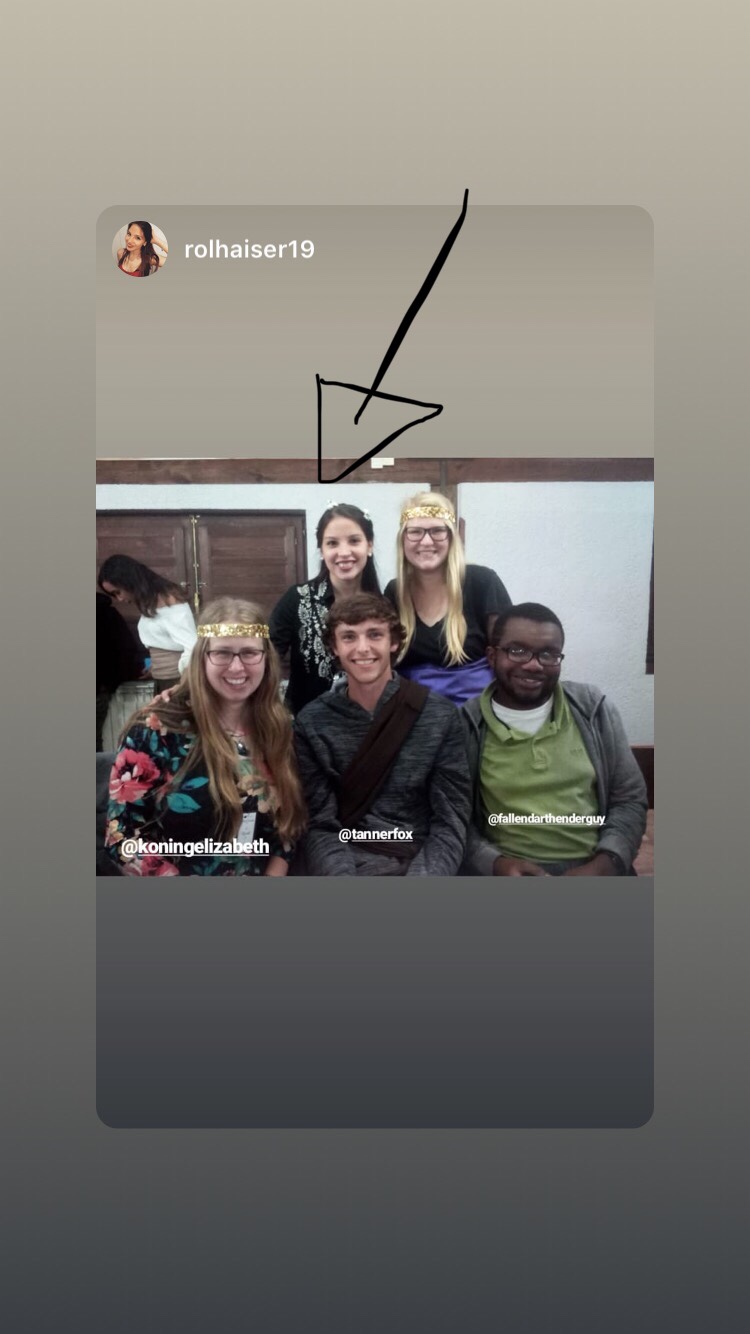
At one of our Bible studies following the youth camp, the topic of first impressions came up, and I told Marisol I had entertained the possibility of her being an angel when I first met her.
Allow me to present my case, readers!
For starters, she just kinda showed up. I had rode up to the camp in Cangas de Onís with Liz, Elizabeth and Tanner, so she wasn’t in our car, nor could I remember at what point she had started talking to us. One second she wasn’t there and the next, she was, chatting away as if we were old friends. She had been a member of Bible study before our arrival, but she only began attending the meetings at the same time as us after the youth camp.
Second off, she helped strangers in need. Most of the campers spoke English, but most of the staffers, including the main speaker, didn’t. Marisol, out of the good of her heart, took the role of our translator.
Third, she disappeared as quickly as she had appeared. When we were packing up to go, she gave us hugs. I looked away for a second and she was gone when I looked back.
Fourth, she is incredibly attractive. (Admittedly, this is the weakest piece of evidence; I’m pretty sure the Bible has no words on angels’ supernatural beauty.)
My case fell apart post-camp, when she hosted Bible study in her apartment and I met her family and learned she was in grad school. So if she is an angel, she’s a pretty deep-cover one.
3. CLARITY!
Youth camp answered a question we didn’t know we had.
For as long as we had been in Spain, Tanner had been received with looks of confusion. Tanner is a bit of an acquired taste: to really appreciate Tanner, you must first accept his having an absurd amount of energy for having a condition that messes with his sleep cycle, and prepare yourself for the hijinks that will come from this. Once you’ve done those two things, you’ll love him. I chalked up people’s confusion with Tanner to cultural differences and moved on.
That was, until Tanner introduced himself to somebody and got the familiar look of confusion and stumbling pronunciation of his name. Thankfully, this person explained their confusion.
To understand, I have to give a short lesson on Spanish linguistics. Every letter in Spanish has a singular sound, as opposed to a hard and soft sound like they do in English. This is why names like Anthony and Matthew have Spanish equivalents, because with each letter having an individual sound, the “th” sound does not compute. As a result of this, double lettering is mostly nonexistent in Spanish (the exception being “ll”, which is pronounced “ee” like in tortilla or pollo). I’m pretty sure a Spanish person trying to pronounce my dad’s name would give themselves a brain bruise.
Well, Tanner has double letters in his name, as well as a very Dutch last name, hence the confusion. (Kassidy had the same problem, but not as badly.) This person also told us that his first name sounded like tañer, the Spanish word for strumming an instrument.
What to take away from this? Thank your lucky stars if your parents gave you a Biblical name, because they cross linguistic lines.
Or something.
4. The Edgelord
Edgelord:
A poster on an Internet forum, (particularly 4chan) who expresses opinions which are either strongly nihilistic, (“life has no meaning,” or Tyler Durden’s special snowflake speech from the film Fight Club being probably the two main examples) or contain references to Hitler, Nazism, fascism, or other taboo topics which are deliberately intended to shock or offend readers.
The term “edgelord,” is a noun, which came from the previous adjective, “edgy,” which described the above behaviour. (urbandictionary.com)
Confession time: I’m a former edgelord. I apologize to anyone who knew me from age 11 to about age 14. That is not to say my sense of black comedy has entirely left me, but that it was its most gratuitous around that time.
Anyhoo…
The campers, particularly the ones around our age, had no shortage of questions about American culture. We did our best to answer. Then this one kid, THE EDGELORD, started in. He asked about those parts of American history that can be summed up with the “side-eying monkey” meme:

We tried to answer the questions and move on, but the guy kept steering the conversation back to slavery or the KKK or something uncomfortable.
About the only good thing that came from this experience is I taught Tanner a new word: edgelord.
EDGELORD, if you’re reading this, I have one thing to say to you:

5. “Poopy”
In this same conversation, I started talking to another guy (whose name I learned and then forgot—sorry, Brazilian guy in Spain). Out of nowhere, he asked me a question: “what is a ‘poopy’?”
I was thrown off, and a little worried where this was going after the impromptu op-ed on slavery I delivered to THE EDGELORD. I started explaining the excretory process, and he stopped me. “Why do you call a poop a ‘poopy’ and an animal a ‘poopy’?” He asked.

This added another layer of confusion to an already confusing conversation.
We went in circles for a few minutes, and another cultural difference emerged as we did. Remember how I said every letter in Spanish has one sound? Well, in Spanish, U is pronounced “ooh”. To a person who has learned English in a Spanish (or Brazilian) school, “puppy”–an infant dog–and “poopy”–the brown stuff deposited in toilets–would be pronounced the same way.
I explained my revelation to this guy, and his curiosity was sated. An anticlimactic ending to a confusing few minutes.
6. Todos nacemos para morir.
Our last story takes place during the sermon on Saturday of our weekend at the camp. Spanish youth camps follow the format of American youth camps: morning/early afternoon service, usually followed by a meal and stuff to do until evening service. Being that the sermons were in Spanish, Marisol, being the beautiful human being she is, voluntarily sat with us and provided a translation. I was only awake to catch bits and pieces of it during the sermons, but when I was, it was helpful.
Well, in this particular service, we sat down from worship and the pastor started in. I only caught every couple of words, but Marisol’s face grew increasingly confused as she listened and translated. I don’t remember the exact message, but it went something like this:
Pastor: *Jesuses in Spanish*
Marisol: We are all born…
Pastor: *more Jesus-ing*
Marisol: …to die.
My Group: *blinks*
The meat of the sermon has been lost to time, but I do remember it being very nihilistic.
So I’m sure THE EDGELORD ate it up.
That will conclude today’s edition of The Lost Stories of Spain. May your names be understandable to Spaniards, your EDGELORDS be nonexistent, and your sermons not sound like Also Sprach Zaruthrustra excerpts.
 The Keene Chronicles